


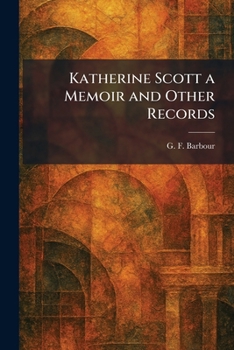
Katherine Scott a Memoir and Other Records

"Katherine Scott a Memoir and Other Records" is a poignant and detailed biographical work that preserves the life and legacy of its namesake. Compiled by the philosopher and writer G. F. Barbour, this volume serves as a comprehensive tribute, blending personal narrative with a curated collection of records that contextualize a life lived during a period of significant social change.
The work offers a deep exploration of Katherine Scott's character, tracing her experiences and the impact she made on those around her. By moving beyond a simple chronological account, the book utilizes letters, journals, and personal recollections to create a multi-dimensional portrait of an individual within the early 20th-century Scottish landscape. Barbour's writing captures the nuances of familial bonds and the quiet strength of character that defined Scott's life.
As a historical and literary artifact, "Katherine Scott a Memoir and Other Records" provides valuable insights into the social history and personal sentiments of its era. It is an essential read for those interested in the art of the memoir, Scottish heritage, and the intimate histories that form the fabric of the past. This volume remains a significant example of how personal records can be woven into a compelling narrative of a life well-remembered.
This work has been selected by scholars as being culturally important, and is part of the knowledge base of civilization as we know it. This work was reproduced from the original artifact, and remains as true to the original work as possible. Therefore, you may see the original copyright references, library stamps (as most of these works have been housed in our most important libraries around the world), and other notations in the work.
This work is in the public domain in the United States of America, and possibly other nations. Within the United States, you may freely copy and distribute this work, as no entity (individual or corporate) has a copyright on the body of the work.
As a reproduction of a historical artifact, this work may contain missing or blurred pages, poor pictures, errant marks, etc. Scholars believe, and we concur, that this work is important enough to be preserved, reproduced, and made generally available to the public. We appreciate your support of the preservation process, and thank you for being an important part of keeping this knowledge alive and relevant.
Customer Reviews
ThriftBooks ® and the ThriftBooks ® logo are registered trademarks of Thrift Books Global, LLC
