


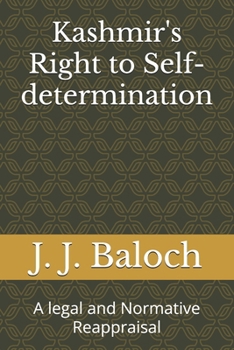
Kashmir's Right to Self-determination: A legal and Normative Reappraisal
No Customer Reviews

This study sheds light on the new post-cold-war democratic right to self-determination in Kashmir's case after India revoked its semi-autonomous status on 5 August 2019. The research will examine how the people of Kashmir qualify the legal and normative benchmarks for invoking their right to self-determination, using the concepts and variables of the struggle for the right to self-determination, denial of autonomy, violation of human rights, peoplehood, alien domination, illegal occupation, international community support for the referendum, and exhaustion of all available options. It attempts to find how remarkable changes have taken place in the legal and theoretical foundations of the doctrine of self-determination in international relations and law over seven decades. The new democratizing and peremptory nature of the right to self-determination and the factual situation of Kashmir in terms of the legal stance of occupying powers, priorities of peoples in Kashmir, and international geo-politics have led to this query. The case study of the revocation of the semi-autonomy status of Jammu and Kashmir by India on 5 August 2019 reveals that India has violated the Treaty of Accession (1948) and Delhi Agreements 1952. At Partition, India's governor general Mountbatten and Jawaharlal Nehru promised the Kashmiri people that the will of the Kashmiri people would settle the final political status, as provided in the Indian Independence Act 1947. The UNSC also endorsed the plebiscite through many UNSC Resolutions. The case of treaty violations falls within the international law of Self-determination. India's revoking the autonomous status of Kashmir raises several interesting questions about international law, namely statehood, self-determination, territorial integrity, and recognition. Many instruments of international law entitled "all peoples", including Kashmiris, to determine their political status, decide their political future, and pursue their economic, social, and cultural development. No book on Kashmir's legal case has ever been written before; there exists some articles only. Therefore, the present volume claims exclusivity.
Format:Paperback
Language:English
ISBN:B0DXPYT4KF
ISBN13:9798859950836
Release Date:August 2023
Publisher:Independently Published
Length:230 Pages
Weight:0.69 lbs.
Dimensions:0.5" x 6.0" x 9.0"
Related Subjects
LawCustomer Reviews
0 rating
Copyright © 2026 Thriftbooks.com
Terms of Use | Privacy Policy | Do Not Sell/Share My Personal Information | Cookie Policy | Cookie Preferences | Accessibility Statement
ThriftBooks ® and the ThriftBooks ® logo are registered trademarks of Thrift Books Global, LLC
ThriftBooks ® and the ThriftBooks ® logo are registered trademarks of Thrift Books Global, LLC
