


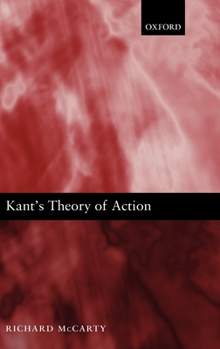
Kant's Theory of Action
No Customer Reviews

The theory of action underlying Immanuel Kant's ethical theory is the subject of this book. What "maxims" are, and how we act on maxims, are explained here in light of both the historical context of Kant's thought, and his classroom lectures on psychology and ethics. Arguing against the current of much recent scholarship, Richard McCarty makes a strong case for interpreting Kant as having embraced psychological determinism, a version of the "belief-desire model" of human motivation, and a literal, "two-worlds" metaphysics. On this interpretation, actions in the sensible world are always effects of prior psychological causes. Their explaining causal laws are the maxims of agents' characters. And agents act freely if, acting also in an intelligible world, what they do there results in their having the characters they have here, in the sensible world. McCarty additionally shows how this interpretation is fruitful for solving familiar problems perennially plaguing Kant's moral psychology.
Format:Hardcover
Language:English
ISBN:0199567727
ISBN13:9780199567720
Release Date:September 2009
Publisher:Oxford University Press
Length:276 Pages
Weight:1.24 lbs.
Dimensions:0.7" x 6.1" x 9.2"
Related Subjects
PhilosophyCustomer Reviews
0 rating
Copyright © 2026 Thriftbooks.com
Terms of Use | Privacy Policy | Do Not Sell/Share My Personal Information | Cookie Notice | Cookie Preferences | Accessibility Statement
ThriftBooks ® and the ThriftBooks ® logo are registered trademarks of Thrift Books Global, LLC
ThriftBooks ® and the ThriftBooks ® logo are registered trademarks of Thrift Books Global, LLC
