


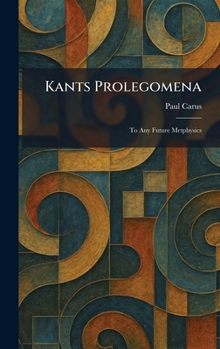
Kants Prolegomena: To Any Future Metphysics

"Kants Prolegomena: To Any Future Metphysics" serves as a fundamental introduction to the revolutionary philosophical system of Immanuel Kant. Designed by the author to provide a more accessible entry point into the dense arguments found in his "Critique of Pure Reason," this work outlines the essential principles of transcendental idealism. Kant explores the limits of human understanding, the nature of space and time, and the conditions under which metaphysics can be considered a rigorous science.
This edition, featuring contributions by Paul Carus, brings clarity to Kant's foundational inquiries: "How is pure mathematics possible?", "How is pure natural science possible?", and "How is metaphysics as a science possible?" By distilling the core of his critical philosophy into a more concise format, "Kants Prolegomena" bridges the gap between abstract reasoning and practical application, making it an indispensable text for students and scholars of modern philosophy.
Kant's investigation into the structures of the mind remains a cornerstone of Western thought, influencing generations of thinkers in logic, ethics, and metaphysics. This work remains a vital guide for anyone seeking to understand the transcendental turn and the shift toward a critical examination of human reason and its boundaries.
This work has been selected by scholars as being culturally important, and is part of the knowledge base of civilization as we know it. This work was reproduced from the original artifact, and remains as true to the original work as possible. Therefore, you may see the original copyright references, library stamps (as most of these works have been housed in our most important libraries around the world), and other notations in the work.
This work is in the public domain in the United States of America, and possibly other nations. Within the United States, you may freely copy and distribute this work, as no entity (individual or corporate) has a copyright on the body of the work.
As a reproduction of a historical artifact, this work may contain missing or blurred pages, poor pictures, errant marks, etc. Scholars believe, and we concur, that this work is important enough to be preserved, reproduced, and made generally available to the public. We appreciate your support of the preservation process, and thank you for being an important part of keeping this knowledge alive and relevant.
Related Subjects
PhilosophyCustomer Reviews
ThriftBooks ® and the ThriftBooks ® logo are registered trademarks of Thrift Books Global, LLC
