


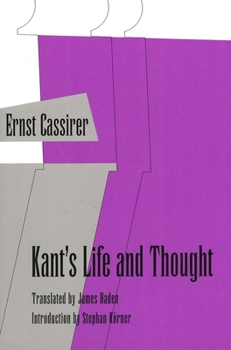
Kants Life and Thought


Select Format
Select Condition 
Book Overview
"Here is the first Kant-biography in English since Paulsen's and Cassirer's only full-scale study of Kant's philosophy. On a very deep level, all of Cassirer's philosophy was based on Kant's, and accordingly this book is Cassirer's explicit coming to terms with his own historical origins. It sensitively integrates interesting facts about Kant's life with an appreciation and critique of his works. Its value is enhanced by Stephen K rner's Introduction, which places Cassirer's Kant-interpretation in its historical and contemporary context."-Lewis White Beck "The first English translation (well done by James Haden) of a 60-year-old classic intellectual biography. Those readers who know Kant only through the first Critique will find their understanding of that work deepened and illuminated by a long explication of the pre-critical writings, but perhaps the most distinctive contribution is Cassirer's argument that the later Critiques, and especially the Critique of Judgment, must be understood not as merely applying the principles of the first to other areas but as subsuming the latter into a larger and more comprehensive framework."-Frederick J. Crown, The Key Reporter "Kant's Life and Thought is that rare achievement: a lucid and highly readable account of the life and work of one of the world's profoundest thinkers. Now for the first time available in an admirable English translation, the book introduces the reader to two of the finest minds in the history of philosophy."-Ashley Montagu
Format:Paperback
Language:English
ISBN:B000H7D04O
ISBN13:9780300029826
Release Date:May 1986
Publisher:Yale University Press
Length:430 Pages
Weight:1.55 lbs.
Dimensions:1.3" x 6.1" x 9.3"
Customer Reviews
3 ratings
Approaching comprehension with great praise
Published by Thriftbooks.com User , 23 years ago
It has been so long since the original German version of this biography of Kant was written by Ernst Cassirer in 1916 (and first published in 1918, due to "the delay inflicted by the war on the progress of the edition of the complete works," (p. 2) according to the Foreword by Ernst Cassirer dated August 14, 1918) that it might be considered quite proper that the recent biography of Kant by Manfred Kuehn deserves to be much more modern in its point of view. My review of Kuehn's book emphasized how modern Kant ought to be considered for someone who lived in his times. Kuehn also put a major emphasis on Kant's desire for perpetual peace, a topic which might have been considered questionable for anyone writing in German at the time when Cassirer was writing this book for use as a supplement to the study of Kant's complete works.I should admit that I have not attempted the study of Kant's work in the manner for which this book is meant to be a guide. I might even be considered too political to be offered a position on such a faculty, so I have no expectation of ever becoming a professional philosopher, and furthermore, I might even be so comical that I would dare to consider Cassirer and Kant as representative of philosophers in the way that Merry and Pippin were typical of hobbits in the movie cycle, "The Lord of the Rings." The set of 4 DVD disks covering the first movie, "The Fellowship of the Ring," allows easy access to specific points in the movie, and scene 44, "The Breaking of the Fellowship," on the second disk, shows the two hobbits (knowing that Frodo Baggins was the only important target) acting as decoys, crying, "Hey! Hey, you! Over here!" Logically, this follows scene 40, "The Fighting Uruk-hai," in which Saruman declares his creation, the Uruk-hai, a perfect creature for war, much as Prussia is described as a highly disciplined place during Kant's life in this book. Philosophically, Kant's writings, which reflect his use of thought processes, can be selected and their relevance to "The whole moral voice of the Enlightenment, as it lived in the purest and greatest spirits," (p. 83) are here demonstrated as logically as Pippin and Merry's exclamations, "It's working!" "I know it's working! Run!" could be considered a histrionic reflection of the admiration for tactics similar to the praise for Kant's philosophy which this book exhibits.This book also exhibits an eagerness to bring God into every discussion in a manner which has become much less popular as the experience of the godly has been tied detrimentally to the likes of Osama bin Laden in the last hundred years or so. My interest in the early part of the book was primarily in comparing the competing Cosmologies of that time. Kant's early work, UNIVERSAL NATURAL HISTORY AND THEORY OF THE HEAVENS (March 14, 1755), which was dedicated just three months before Kant became a doctor of philosophy on the strength of his treatise, DE IGNE (ON FIRE), was not well known in his t
What is Enlightenment?
Published by Thriftbooks.com User , 26 years ago
One of the mysteries of the rise of the modern world is the sudden appearance of the grand phase of German philosophy beginning with the work of Kant, as his thought suddenly flowered late in life with his precipitous Critique of Pure Reason. Like an echo reverberating across the ages, Kant's breakthrough both recovered and surpassed the height to which philosophy had reached in Plato. This thunderclap just at the takeoff of the revolutionary passage to a new era is the prelude to an entire new universe of thinking, and joins the world of science, the Enlightenment, with a world as ancient as the Upanishads and as futuristic as Quantum Mechanics. Cassirer's philosophical biography is one of the clearest and most cogent introductions to the Kant's life and work and is a classic in its own right.
A Rewarding Read
Published by Thriftbooks.com User , 26 years ago
Over the past few years, I had increasingly developed an interest in the Kantian system. I had approached several of Kant's most important works in order to gain an understanding of his thought, but I found that I often struggled to make clear sense of many of his ideas. Although I had obtained a basic knowledge of his philosophy and some lasting insights from these works, I found that Kant's method of presentation often presented some difficulties regarding a complete understanding of them.Ernst Cassirer's book provides the student of philosophy with an excellent elucidation of Kant's system of critical thought and both the characteristics of this philosopher's personality and the currents of thought that were prevalent during and preceding his lifetime that led him to develop the philosophic views for which he is well-known. Cassirer also amalgamates Kant's theoretical, ethical, and aesthetic aims into a whole system that reflects Kant's fundamental philosophical outlook. A great deal of material containing many subtle and frequently misconceived points is presented in a very clear, though well-detailed, way. Cassirer's discussion of the Critique of Judgment, a book that has long stupified many readers, is especially thought-provoking. The impression one receives of Cassirer's deep admiration is understandable given the astonishing intellectual depth and breadth of Kant's achievements This book is highly recommended for anyone seeking a more profound understanding of Kant's life and works.
Copyright © 2026 Thriftbooks.com
Terms of Use | Privacy Policy | Do Not Sell/Share My Personal Information | Cookie Policy | Cookie Preferences | Accessibility Statement
ThriftBooks ® and the ThriftBooks ® logo are registered trademarks of Thrift Books Global, LLC
ThriftBooks ® and the ThriftBooks ® logo are registered trademarks of Thrift Books Global, LLC
