


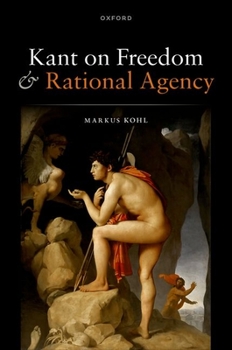
Kant on Freedom and Rational Agency
No Customer Reviews

Kant on Freedom and Rational Agency provides a novel interpretation and rational reconstruction of Kant's doctrine of freedom. Markus Kohl shows how Kant defends the belief that we are free from foreign (natural and super-natural) causes as a presupposition of all meaningful human activity. While this interpretation focuses on the essential role that freedom of will plays in our moral agency, it also examines how our status as rational cognitive agents hinges on our freedom of thought, and why our aesthetic engagement with beauty requires our freedom of imagination. Kohl thereby gives a compelling sense of Kant's estimation that freedom is a "cardinal point"--even the "keystone"--of his entire critical philosophy. Kant's doctrine of freedom emerges in this account as a systematic critique of a naturalistic worldview which regards all our capacities, representations, and actions as the causal upshot of natural laws and forces. Kant holds that the naturalistic worldview fatally undermines our self-conception as rational agents. This critique of naturalism culminates in the argument that naturalistic cognizers cannot explain away our freedom from natural forces because they must presuppose such a freedom in their own cognitive efforts to devise rationally valid naturalistic theories.
Format:Hardcover
Language:English
ISBN:019887314X
ISBN13:9780198873143
Release Date:July 2023
Publisher:Oxford University Press
Length:410 Pages
Weight:1.73 lbs.
Dimensions:1.1" x 6.4" x 9.4"
Related Subjects
PhilosophyCustomer Reviews
0 rating
Copyright © 2026 Thriftbooks.com Terms of Use
| Privacy Policy | Do Not
Sell/Share My Personal Information | Cookie Policy | Cookie Preferences | Accessibility Statement
ThriftBooks® and the ThriftBooks® logo are registered trademarks of Thrift Books Global, LLC
ThriftBooks® and the ThriftBooks® logo are registered trademarks of Thrift Books Global, LLC
