


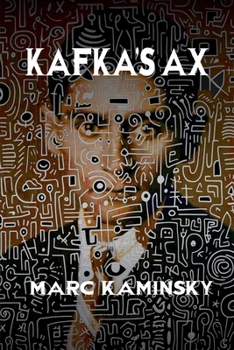
Kafka's Ax

Borges tells us that our greatest artists disappear into their auras, the most public and least knowable of humans. We all feel at home with Kafka, the virtuoso of paradox, the patron saint of noir. Marc Kaminsky has taken on a visionary task: to restore the contingency of the living to a dead icon, to invoke a deeply complex mind, terrified of its own contradictions and caught in the peculiar character of a culture and a moment of time: h]ow could he be proof/against the myth of redemption/when his sense of sin/was more real to him/than
his own right hand?"
Deploying all the resources of a great poet, a wildly imaginative orchestra of tones and authorial stances, and an intimate knowledge of Jewish sources and academic tropes, Kaminsky takes us on a riveting journey toward the human. His book is both a poem and an anti-myth, a critique of the objectification inherent in authorial bias.
Kaminsky won't force feed you "the definitive Kafka" he will suggest a thousand paths toward a Kafka who is free to remain a stranger, vulnerable, sundered, living. Kafka's Ax is a lifework, a crowning achievement of one of our important writers and thinkers.
-D. NURSKE, author of A Night in Brooklyn
Author's Note
Many of the poems and prose pieces in this book are collaged texts, combining fragments of Kafka with imaginative and documentary writing. My key documentary sources include Kafka's Diaries, Max Brod's Franz Kafka: A Biography, Ernst Pawel's Franz Kafka: The Nightmare of Reason, and Reiner Stach's Kafka: The Decisive Years and Kafka: The Years of Insight. This work is a midrash-a speculative narrative and commentary-written from the perspectives of Kafka, some of the people in his life (Max Brod, Yitzkhok Leyvi, Dora Diamont, Kafka's father Hermann) and a variety of fictional characters (participants at a fictional Kafka conference, as well as a Yiddish folksinger/independent scholar, a Yiddish actor, and a refugee-informant). Sources of the collaged texts are cited in the Source Notes.
Customer Reviews
ThriftBooks® and the ThriftBooks® logo are registered trademarks of Thrift Books Global, LLC
