


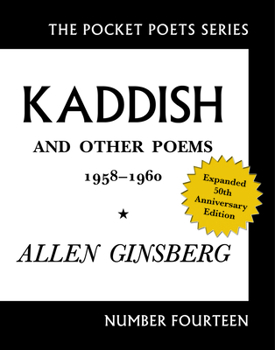
Kaddish and Other Poems: 1958-1960

Select Format
Select Condition 
Book Overview
"As a pandemic rages and we are unable to gather to celebrate our dead, make our minyans, or hold one another's hands, have our seders, I think of Ginsberg writing Kaddish for his mother. I think of him imagining a journey from bondage to freedom. . . . Kaddish is the perfect poem for these times."--Laurel Brett, The Forward
Allen Ginsberg's "Kaddish," a poem about the death of his mother, Naomi, is one of his major works. This special fiftieth anniversary edition of Kaddish and Other Poems features an illuminating afterword by Ginsberg biographer Bill Morgan, along with previously unpublished photographs, documents, and letters relating to the composition of the poem.
Allen Ginsberg, founding father of the Beat Generation, inspired the American counterculture of the second half of the twentieth century with his groundbreaking poems.
Bill Morgan is the author of I Celebrate Myself: The Somewhat Private Life of Allen Ginsberg. He lives in New York City and Bennington, Vermont.
"In the midst of the broken consciousness of mid-twentieth century suffering anguish of separation from my own body and its natural infinity of feeling its own self one with all self, I instinctively seeking to reconstitute that blissful union which I experience so rarely. I took it to be supernatural and gave it holy Name thus made hymn laments of longing and litanies of triumphancy of Self over mind-illusion mechano-universe of un-feeling Time in which I saw my self my own mother and my very nation trapped desolate our worlds of consciousness homeless and at war except for the original trembling of bliss in breast and belly of every body that nakedness rejected in suits of fear that familiar defenseless living hurt self which is myself same as all others abandoned scared to own unchanging desire for each other."--Allen Ginsberg from Kaddish
"Kaddish, Ginsberg's ode to his mother after her death, is streaked with references to Judaism and to the funerary prayer recited by a male mourner for the passing of a parent or relative. Like the prayer, Ginsberg's poem is a celebration of his mother, but it also delves into--and, indeed, dwells on--the darker side of her life. . . . Ginsberg bears witness to his mother's pain and struggles; he intones her name--another act of remembrance--over and over again as if to deify her."--Maria Eliades, Ploughshares
"Kaddish, Allen Ginsberg's most stunning and emotional poem, tells a story that is entirely true. As a young boy growing up in Paterson, New Jersey, Allen watched his mother succumb to a series of psychotic episodes that grew progressively worse despite desperate attempts at treatment."--Levi Asher, Literary Kicks
Kaddish, which Ginsberg wrote between 1957 and 1959 and published in 1961, is, at its core, a poem about a son learning to grieve for his mother. But Ginsberg's emotional and intellectual rawness make this poem an investigation about what it means to grieve, or even to be a son or mother. A deeply intimate portrait of his family's life, Kaddish nonetheless embeds itself in specific historical contexts: of Jewish life in the United States and after the Holocaust, of left-wing political activism before and during the Cold War, of a fiercely independent woman who died as second-wave feminism was only just beginning to be formulated."--Joshua Logan Wall, The Yiddish Book Center's "Great Jewish Books, Teacher Resources"
"Ginsberg's long, graphic, lamenting elegy for his mother is one of the most shattering poems written in this century. Harrowing. Grotesque. Hilarious. Non-stop in its verbal energy....I love these little City Lights collections--they're certainly more fun than the big Collected Poems (Harper), easier to carry, easier to hold, and easier to read."--Lloyd Schwartz, Grolier Poetry Book Shop
Customer Reviews
After 'HOWL', It's 'KADDISH'
a mother's madness
Nice little collection
the poet who brings dignety to madnes
ThriftBooks ® and the ThriftBooks ® logo are registered trademarks of Thrift Books Global, LLC
