


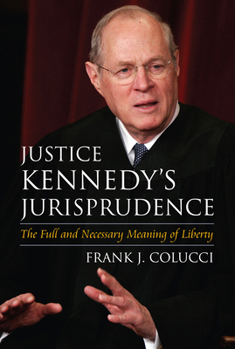
Justice Kennedy's Jurisprudence: The Full and Necessary Meaning of Liberty

To understand today's Supreme Court, it is essential to understand the judicial philosophy of its swing vote. For twenty years, Justice Anthony M. Kennedy has voted with the majority more than any of his colleagues. He has provided the deciding vote in cases involving politically charged issues such as affirmative action, the 2000 presidential election, religious expression, gay rights, and executive power to detain suspected terrorists. With a record reliably neither liberal nor conservative, Kennedy has generally been viewed as a capricious, indecisive moderate. Frank Colucci, however, argues that Kennedy indeed displays a coherent approach to constitutional interpretation. Colucci digs deep into the Justice's record, offering a close analysis of not only of Kennedy's opinions on the Court but also his prior opinions on the 9th Circuit Court of Appeals, his off-the-bench speeches delivered before becoming a Justice, and his testimony at confirmation hearings. Colucci identifies Kennedy's core belief: that judges have a duty to ensure the word liberty in the Constitution be given its full and necessary meaning. Colucci shows that Kennedy rejects theories of originalism and judicial restraint. Instead, Kennedy adopts a moral reading of the Constitution--similar to that championed by Ronald Dworkin and Randy Barnett as well as former Justice William J. Brennan--in which liberty and human dignity trump even democracy. Depicting Kennedy as seeking an alternative to the perceived excesses of both the Warren Court and originalist overreaction, Colucci also compares Kennedy's rhetoric to Catholic teaching and shows him as struggling to disassociate his personal beliefs from his official duties. Separate chapters offer close readings of Kennedy's jurisprudence regarding abortion, free speech, equality, and government structure. Colucci's persuasive account offers readers a more nuanced understanding of Justice Kennedy's arguments about the nature of personal liberty and the proper role of courts in defining and enforcing it.
Format:Hardcover
Language:English
ISBN:0700616624
ISBN13:9780700616626
Release Date:September 2009
Publisher:University Press of Kansas
Length:256 Pages
Weight:1.20 lbs.
Dimensions:0.9" x 6.2" x 9.2"
Customer Reviews
1 rating
A New Standard
Published by Thriftbooks.com User , 16 years ago
Frank Colucci has succeeded where others have failed: he has distilled from Justice Kennedy's seemingly disparate judicial opinions a coherent explanation of the principles that guide Kennedy's jurisprudence. Justice Kennedy is undoubtedly the most influential member of the current Supreme Court; he is also the most enigmatic. In the past, many scholars have attempted to understand his mind, but have universally fallen flat. Some have fancifully suggested that he is a libertarian. Others have claimed he is controlled by his clerks- as if Justice Kennedy could be controlled by anyone. A number of commentators have attempted to chart his "shifts" to the "left" or "right". Some have contented themselves to merely trying to makes sense of a few of his apparently conflicting opinions, without attempting to develop a full-fledged explication of his broader method. Others have thrown up their hands and said that he is simply unprincipled and inconsistent. Colucci makes the case that Kennedy is neither unprincipled nor inconsistent. Colucci begins where others have not: by looking at Kennedy's opinions on the 9th Circuit before he became a Justice, as well as his out-of-court statements about the law. Working from there, Colucci offers a convincing account of Justice Kennedy's judicial methodology, and shows that he has consistently followed it from pre-appointment to the present. Going forward, scholars- both in law and political science- can no longer claim that Justice Kennedy is arbitrary without responding to Colucci's work. For academics, practitioners, and anyone else looking to understand how Justice Kennedy's mind works, this book is a must read.
Copyright © 2026 Thriftbooks.com Terms of Use
| Privacy Policy | Do Not
Sell/Share My Personal Information | Cookie Policy | Cookie Preferences | Accessibility Statement
ThriftBooks® and the ThriftBooks® logo are registered trademarks of Thrift Books Global, LLC
ThriftBooks® and the ThriftBooks® logo are registered trademarks of Thrift Books Global, LLC
