


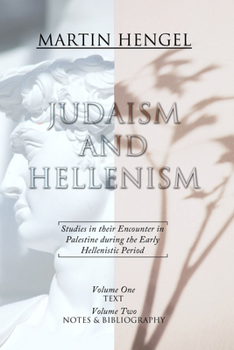
Judaism and Hellenism

Select Format
Select Condition 
Book Overview
Martin Hengel gathers an encyclopedic amount of material, ancient and modern, to present an exhaustive survey of the early course of Hellenistic civilization as it related to developing Judaism. The result is a highly readable account of a largely unfamiliar world which is indispensable for those interested in Judaism and the birth of Christianity alike. An extensive section of notes and bibliography is included.
Format:Paperback
Language:English
ISBN:1592441866
ISBN13:9781592441860
Release Date:March 2003
Publisher:Wipf & Stock Publishers
Length:666 Pages
Weight:2.03 lbs.
Dimensions:1.4" x 6.1" x 9.1"
Customer Reviews
1 rating
Highly influential book by a world class scholar
Published by Thriftbooks.com User , 17 years ago
Martin Hengel, considered one of the top biblical scholars in the world, published this book about 1970. It has since influenced a generation of scholars, being cited in hundreds of publications. The book was published in two volumes, with volume one being the book itself, and volume two being the notes and index. The old History of Religions theory had crashed to an inglorious end when Hengel published this book. Hengel's conclusion was that "It is not possible to say that Judaism maintained a straight course through the Hellenistic period...Still less can it be claimed that it was completely permeated by the Hellenistic spirit" (p310). The 'wisdom school' was influenced by Greek thought, which among the people took on a strong eschatological expectation. Still, Hengel insists that Judaism maintained its singularity. "The almost complete fusion of religion and nationalism... prevented any assimilation" (p 313). Among the Greek influences were the 100 years Palestine was under the Ptolemies, Attic pottery, the Greek language, irrigation, and minted money. "Interest in Hellenistic civilization, however, remained predominantly limited to the well-to-do aristocracy of Jerusalem" (p 56). So did that main pipeline of Hellenism, Greek schools. Earlier schools among the Jews were "exclusive, status-conscious... scribal schools" (p 80). Among the Jewish people, even as Hellenism was influencing their elite, elementary schools were formed that had enormous impact on the common people. The idea was to educate every Jewish boy. Simeon b Setah ordered all Jewish boys to go to school. So did Jubilees. "The school age was set a 6-7...non-Jews and Samaritans were prohibited as teachers...Instead of Homer, the Hebrew Bible, especially the Pentateuch, held pride of place in instruction" (p 82). Instruction was to continue for 10 years. The Cynic philosopher Oenomaus said, "'Go and observe their synagogues and schools..you cannot succeed'" in changing the Jews, because of those schools and synagogues. The result of this education system was a burst of literary creativity. "It is astonishing what creative forces were developed in their small and relatively remote Jewish temple state measuring barely more than twenty-four miles across, during the Persian and early Hellenistic period" (p 113). Hengel argues that the Septuagint was influenced very little by Hellenism. And that Ben Sira "By asserting that all wisdom comes from the Lord...formulates a Jewish declaration of war against Hellenism" (p 138).
Copyright © 2026 Thriftbooks.com Terms of Use
| Privacy Policy | Do Not
Sell/Share My Personal Information | Cookie Policy | Cookie Preferences | Accessibility Statement
ThriftBooks® and the ThriftBooks® logo are registered trademarks of Thrift Books Global, LLC
ThriftBooks® and the ThriftBooks® logo are registered trademarks of Thrift Books Global, LLC
