


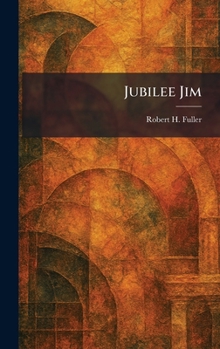
Jubilee Jim

"Jubilee Jim" is a vibrant and detailed biographical account of James Fisk, one of the most flamboyant and controversial figures of the American Gilded Age. Known as the "Barnum of Wall Street," Fisk's life story serves as a window into a transformational era of industrial growth, financial manipulation, and public spectacle. Robert H. Fuller captures the essence of a man who rose from humble beginnings as a peddler to become a titan of the Erie Railroad and a central player in the infamous Black Friday gold market crash of 1869.
Through a narrative that blends historical fact with the dramatic flair suitable for its subject, the work explores Fisk's audacious business tactics, his fierce rivalry with other powerful financiers like Cornelius Vanderbilt, and his high-profile personal life. The book illustrates the social and economic tensions of late 19th-century New York, depicting a world where massive fortunes were made and lost in a single day. "Jubilee Jim" remains a compelling study of the psychology of enterprise and the larger-than-life personalities who shaped the modern American economic landscape during a period of unbridled capitalism and rapid national expansion.
This work has been selected by scholars as being culturally important, and is part of the knowledge base of civilization as we know it. This work was reproduced from the original artifact, and remains as true to the original work as possible. Therefore, you may see the original copyright references, library stamps (as most of these works have been housed in our most important libraries around the world), and other notations in the work.
This work is in the public domain in the United States of America, and possibly other nations. Within the United States, you may freely copy and distribute this work, as no entity (individual or corporate) has a copyright on the body of the work.
As a reproduction of a historical artifact, this work may contain missing or blurred pages, poor pictures, errant marks, etc. Scholars believe, and we concur, that this work is important enough to be preserved, reproduced, and made generally available to the public. We appreciate your support of the preservation process, and thank you for being an important part of keeping this knowledge alive and relevant.
Customer Reviews
ThriftBooks ® and the ThriftBooks ® logo are registered trademarks of Thrift Books Global, LLC
