


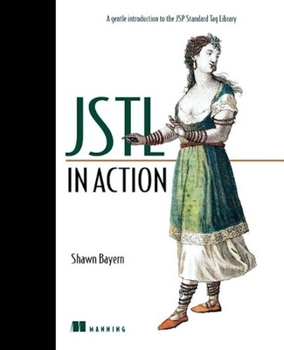
Jstl in Action

Introducing Web page authors and programmers to the JSP Standard Tag Library (JSTL), this guide covers all features of the JSTL 1.0 standard. Whether users need to add dynamic content to a static Web page or are in need of providing back-end code, nonprogrammers are shown how to manipulate XML, access relational databases, format text, internationalize Web applications, and introduce general-flow logic into JSP--all with HTML-like tags that are accessible to authors of Web pages. Also addressed are techniques for utilizing and extending JSTL's functionality.
Format:Paperback
Language:English
ISBN:1930110529
ISBN13:9781930110526
Release Date:July 2002
Publisher:Manning Publications
Length:480 Pages
Weight:1.80 lbs.
Dimensions:1.0" x 7.5" x 9.3"
Customer Reviews
5 ratings
Very good JSTL book!
Published by Thriftbooks.com User , 22 years ago
ReviewOne way to develop dynamic page content on a web application is to use JavaServer Pages technology. This allows you to embed bits of Java code, or scriptlets, within the HTML page. The web server interprets the scriptlet when the page is called and produces the content that is coded. This is all good, but there are common tasks (such as looping) that each developer had to reinvent from scratch each time it was used in a page. To prevent this repetitive coding, a common set of JSP tags were created to allow developers to concentrate on business logic instead of coding structures. This creation is known as the JSP Standard Tag Library (JSTL). That's what this book is all about...The book starts with an examination of how JSP and XML tags come together to form the basis of JSTL. This is followed by a number of chapters that cover the different tags that are used to control branching, flow, text formatting, and other various structures. After the basics of JSTL, the author looks at a number of common tasks encountered by JSP developers and how they would be coded using JSTL. Finally, the book wraps up with reference data needed on a regular basis as you use JSTL, such as the API.The writing is clear and concise, with an abundance of diagrams and code to illustrate the points. The mix of reference, tutorial, and practical examples is perfect, and every developer will be able to use this book in a number of situations.Websphere developers (both web application and portlet development) will get the most out of this book when it comes to the IBM/Lotus world. The use of JSTL will reduce the code complexity of your JSP pages and speed up your development efforts. ConclusionIf you are developing JSP pages and haven't looked into the use of the JSTL area, get this book. It will save you time and effort in your coding, and you'll be glad you did.
The best book on JSTL and taglibs!
Published by Thriftbooks.com User , 22 years ago
I'm actually awestruck and definitely pleased that Shawn is a developer and writes so well! JSTL is a hot topic these days, especially when it comes to Struts and other JSP Frameworks. Shawn presents an excellent description of JSTL and it's abilities, and stresses how easy it's evaluation language is to use.As a Struts programmer and architect, This book allowed me to see how many of the Struts-tags overlap with the JSTL, and I believe Shawn's work gave me the inspiration and critical knowledge I need to implement JSTL in my future projects. He treats JSTL tags as what they are -- more tools in my toolbox, not a reason to dump what I already know.A note to developers - Be careful with JSTL if you have concerns about MVC architecture, because JSTL crosses the line in a couple of places (sql and xml tags). Shawn addresses this quite well in his book.If you're reading this review, you're probably familiar with, or already programming Struts. This book will most definitely help you stay ahead of the curve and I highly recommend it!
Another Friend in the Book Case
Published by Thriftbooks.com User , 23 years ago
Good programming books are not rampant. Manning tends to be a great source, however. They've done it again with this book. And, this time, they have the added attraction of a great, adult sense of humour with Shawn Bayern. If you cannot use JSTL with ease after reading this book, then you will be in the minority. I don't know if Bayern makes the hard easy or the easy easy, but it definitely is made easy. I sailed through this book wondering how 400 plus pages could seem like 90 pages. The best thing is that there is a forest for the trees to live in throughout this book. Bayern is a great teacher. I'm going to look at his other book now. Maybe it is good too.
Best Available
Published by Thriftbooks.com User , 23 years ago
This is by far the best JSTL Book on the Market at this time. The Book was organized and well written and their were plenty of good examples. I would have liked to have had more Chapters that were aimed at Java Programmer's but that wasn't the purpose of the Book.
Very useful and understandable
Published by Thriftbooks.com User , 23 years ago
While the technical specification of JSTL is readable like most hi-tech documents are "readable" (i.e. it left me sometimes a bit puzzled), this book is both deep and full of very useful examples. Sometimes, in my opinion it goes too far (programming a message board with JSTL), but this only goes to show how powerful JSTL really is.Overall, I really enjoyed reading it: It made a lot of things clearer and there were a couple of times where I thought: "Oh, I didn't know that JSTL could do that!".
Copyright © 2026 Thriftbooks.com Terms of Use
| Privacy Policy | Do Not
Sell/Share My Personal Information | Cookie Policy | Cookie Preferences | Accessibility Statement
ThriftBooks® and the ThriftBooks® logo are registered trademarks of Thrift Books Global, LLC
ThriftBooks® and the ThriftBooks® logo are registered trademarks of Thrift Books Global, LLC
