


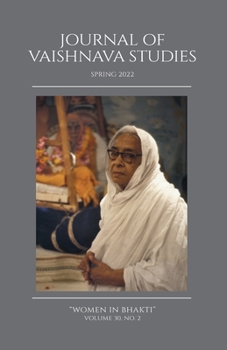
Journal of Vaishnava Studies: Spring 2022 "Women in Bhakti"
No Customer Reviews

In India, the history of feminism can be divided into two major phases. The first began in the mid-19th century, when reformists fought for equal rights in terms of education and the strengthening of female involvement in civil and religious arenas. The second came after independence (1947), focusing more on the equitable treatment of women in the home, particularly after marriage, as well as equality in the work force and in the political arena. This culminated, of course, with
Indira Gandhi becoming the first female Prime Minister of India. By 2020, she was named by Time magazine as being among the world's 100 most powerful women of all time, as memorialized in their 1976 special covers edition . The above background might be useful in understanding the complexity of the female plight in India, which has been mixed, even for Vaishnavis. While women who engage in Vaishnava dharma have largely been protected by their tradition
with the insights that come from spiritual awareness, they, too have been subject to the political and social upheaval that virtually defines the world around them. While some of the women covered in this volume, such as Viṣṇupriyā and Jāhnavā, are considered female divinities, and so may not have suffered at the hands of a largely patriarchal society, others, such as the widows of VrinVrindavan, have clearly experienced life somewhat differently, and that too will be explored here. Most women fall somewhere in between, with glorious and rewarding insights and spiritual riches,
counterbalanced by setbacks perpetrated by the culture in which they live. In short, we have tried to represent both the positive and the negative to give a balanced view of what it means to be a Vaishnavi, or a female devotee o Lord Krishna.
Indira Gandhi becoming the first female Prime Minister of India. By 2020, she was named by Time magazine as being among the world's 100 most powerful women of all time, as memorialized in their 1976 special covers edition . The above background might be useful in understanding the complexity of the female plight in India, which has been mixed, even for Vaishnavis. While women who engage in Vaishnava dharma have largely been protected by their tradition
with the insights that come from spiritual awareness, they, too have been subject to the political and social upheaval that virtually defines the world around them. While some of the women covered in this volume, such as Viṣṇupriyā and Jāhnavā, are considered female divinities, and so may not have suffered at the hands of a largely patriarchal society, others, such as the widows of VrinVrindavan, have clearly experienced life somewhat differently, and that too will be explored here. Most women fall somewhere in between, with glorious and rewarding insights and spiritual riches,
counterbalanced by setbacks perpetrated by the culture in which they live. In short, we have tried to represent both the positive and the negative to give a balanced view of what it means to be a Vaishnavi, or a female devotee o Lord Krishna.
Format:Paperback
Language:English
ISBN:B0B6L59YL9
ISBN13:9798840158951
Release Date:June 2022
Publisher:Independently Published
Length:260 Pages
Weight:0.73 lbs.
Dimensions:0.6" x 5.5" x 8.5"
Customer Reviews
0 rating
Copyright © 2026 Thriftbooks.com
Terms of Use | Privacy Policy | Do Not Sell/Share My Personal Information | Cookie Policy | Cookie Preferences | Accessibility Statement
ThriftBooks ® and the ThriftBooks ® logo are registered trademarks of Thrift Books Global, LLC
ThriftBooks ® and the ThriftBooks ® logo are registered trademarks of Thrift Books Global, LLC
