


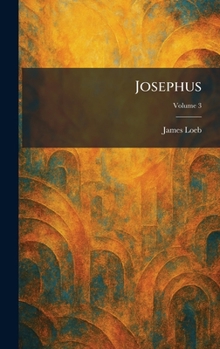
Josephus

In this third volume of "Josephus", the historical narrative of Flavius Josephus continues its expansive exploration of the Jewish people, focusing on the "Jewish Antiquities". As a 1st-century Romano-Jewish historian, Josephus offers an unparalleled look into the traditions, laws, and political evolution of ancient Israel, specifically designed to bridge the cultural gap between Jewish heritage and the broader Greco-Roman world.
This volume provides a detailed recounting of the foundational periods of Jewish history, tracing the lineage and governance of the Hebrew people. Josephus blends theological insights with the rigorous standards of classical history, preserving crucial accounts of leadership, conflict, and societal development that are not found in other contemporary sources. His work is essential for understanding the cultural and religious landscape that defined the ancient Near East under Roman rule.
"Josephus" remains a vital resource for scholars of theology, archaeology, and ancient history. This translation preserves the scholarly integrity of the text while making the complex social and political dynamics of the period accessible to modern readers. It stands as a monumental achievement in historiography, documenting the resilience and identity of a nation during a pivotal era of human history.
This work has been selected by scholars as being culturally important, and is part of the knowledge base of civilization as we know it. This work was reproduced from the original artifact, and remains as true to the original work as possible. Therefore, you may see the original copyright references, library stamps (as most of these works have been housed in our most important libraries around the world), and other notations in the work.
This work is in the public domain in the United States of America, and possibly other nations. Within the United States, you may freely copy and distribute this work, as no entity (individual or corporate) has a copyright on the body of the work.
As a reproduction of a historical artifact, this work may contain missing or blurred pages, poor pictures, errant marks, etc. Scholars believe, and we concur, that this work is important enough to be preserved, reproduced, and made generally available to the public. We appreciate your support of the preservation process, and thank you for being an important part of keeping this knowledge alive and relevant.
Customer Reviews
ThriftBooks ® and the ThriftBooks ® logo are registered trademarks of Thrift Books Global, LLC
