


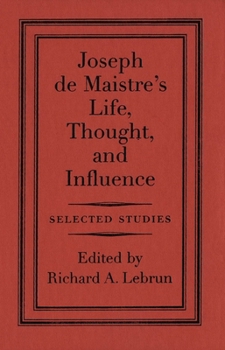
Joseph de Maister: An Intellectual Militant
No Customer Reviews

Joseph de Maistre is the first full biography in English of one of the founders of conservatism, and the first to have benefited from access to the family archives. Understanding the dynamics of Maistre's political evolution contributes both to our knowledge of continental conservatism as it emerged from the crucible of the French Revolution and to a better understanding of the roots of modern conservatism.
In France, where his stature as a great stylist has generally been acknowledged, Maistre is often dismissed with a brief remark about his scandalous comments on bloodshed and war. This dismissal is unwarranted: study of Maistre's life and thought is worthwhile in itself and provides useful insights into the factors that encourage the formulation and acceptance of conservative or reactionary ideologies. The Joseph de Maistre revealed here is a more complex figure than either the bloody-minded apologist for conservatism portrayed by his liberal critics or the steadfast Church Father of his traditional Catholic admirers. Maistre was a scholarly magistrate in the tradition of Montesquieu, a man who had been open to the trends of his time but was profoundly shaken by the violence of the French Revolution. Appalled by the prospect of chaos, he used his rhetorical skills as a lawyer to defend monarchical institutions and traditional Catholicism. Lebrun argues that only with the opening of the family archives and the discoveries in recent studies are we able to appreciate Maistre's struggles to understand the upheavals of his time, his doubts and hesitations, and his reasons for taking the public positions he chose.Format:Hardcover
Language:English
ISBN:0773506454
ISBN13:9780773506459
Release Date:June 1988
Publisher:McGill-Queen's University Press
Length:384 Pages
Weight:1.65 lbs.
Dimensions:1.0" x 6.0" x 9.0"
Customer Reviews
0 rating
Copyright © 2026 Thriftbooks.com
Terms of Use | Privacy Policy | Do Not Sell/Share My Personal Information | Cookie Policy | Cookie Preferences | Accessibility Statement
ThriftBooks ® and the ThriftBooks ® logo are registered trademarks of Thrift Books Global, LLC
ThriftBooks ® and the ThriftBooks ® logo are registered trademarks of Thrift Books Global, LLC
