


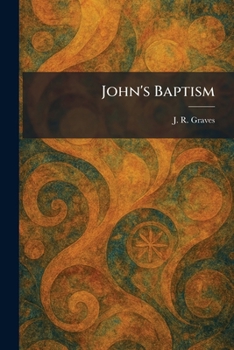
John's Baptism

"John's Baptism" is a profound theological study that examines the nature, purpose, and significance of the baptism administered by John the Baptist. Written by the influential theologian and Landmark Baptist leader J. R. Graves, this work delves into the scriptural foundations of the ordinance, arguing for its central role in the establishment of the Christian church and the gospel dispensation. Graves meticulously explores the distinctions between John's baptism and later Christian practices, emphasizing the necessity of proper authority, the correct mode of immersion, and the specific qualifications for candidates.
Throughout the text, Graves engages with biblical exegesis to defend a specific ecclesiological vision that has deeply influenced Baptist tradition. He addresses controversial questions regarding the validity of various baptisms and the continuity of the church from the days of the New Testament. This volume serves as an essential resource for those interested in historical theology, Baptist history, and the development of denominational identity. "John's Baptism" offers a rigorous defense of traditional Baptist views on the sacraments, making it a valuable addition to any library focused on Christian doctrine and the origins of the faith.
This work has been selected by scholars as being culturally important, and is part of the knowledge base of civilization as we know it. This work was reproduced from the original artifact, and remains as true to the original work as possible. Therefore, you may see the original copyright references, library stamps (as most of these works have been housed in our most important libraries around the world), and other notations in the work.
This work is in the public domain in the United States of America, and possibly other nations. Within the United States, you may freely copy and distribute this work, as no entity (individual or corporate) has a copyright on the body of the work.
As a reproduction of a historical artifact, this work may contain missing or blurred pages, poor pictures, errant marks, etc. Scholars believe, and we concur, that this work is important enough to be preserved, reproduced, and made generally available to the public. We appreciate your support of the preservation process, and thank you for being an important part of keeping this knowledge alive and relevant.
Customer Reviews
ThriftBooks ® and the ThriftBooks ® logo are registered trademarks of Thrift Books Global, LLC
