


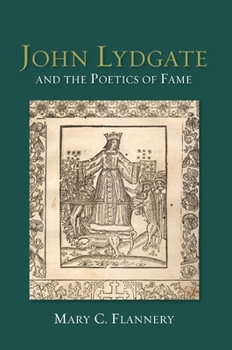
John Lydgate and the Poetics of Fame
No Customer Reviews

An examination of the subject of fame in Lydgate, showing it as central to his work. John Lydgate is arguably the most significant poet of fifteenth-century England, yet his position as Chaucer's literary successor and his role as a Lancastrian poet have come to overshadow his contributions to English literature.Here, fame is identified as the key to Lydgate's authorial self-fashioning in Chaucer's wake. The author begins by situating Lydgatean fame within the literary, cultural and political landscape of late-medieval England, indicating how Lydgate diverges from Chaucer's treatment of the subject by constructing a more confident model of authorship, according to which poets are the natural makers and recipients of fame. She then discusses the ways in which Lydgate draws on fourteenth-century poetry, the advisory tradition, and the laureate ideology borne out of trecento Italy; she shows that he deploys them to play upon reader anxieties in his short poems on dangerous speech, while depicting poets as the ultimate arbiters of fame in his longer poems and dramatic works.
Throughout, the book challenges standard critical positions on questions relating to how poets fit into late-medieval society, how they canbe powerful enough to admonish princes, and how English letters fare next to the literature of the continent and of antiquity. Mary C. Flannery is Lecturer in English at the University of Lausanne.
Throughout, the book challenges standard critical positions on questions relating to how poets fit into late-medieval society, how they canbe powerful enough to admonish princes, and how English letters fare next to the literature of the continent and of antiquity. Mary C. Flannery is Lecturer in English at the University of Lausanne.
Format:Hardcover
Language:English
ISBN:1843843315
ISBN13:9781843843313
Release Date:November 2012
Publisher:Boydell & Brewer
Length:206 Pages
Weight:1.15 lbs.
Dimensions:0.7" x 6.3" x 9.5"
Customer Reviews
0 rating
Copyright © 2025 Thriftbooks.com
Terms of Use | Privacy Policy | Do Not Sell/Share My Personal Information | Cookie Policy | Cookie Preferences | Accessibility Statement
ThriftBooks ® and the ThriftBooks ® logo are registered trademarks of Thrift Books Global, LLC
ThriftBooks ® and the ThriftBooks ® logo are registered trademarks of Thrift Books Global, LLC
