


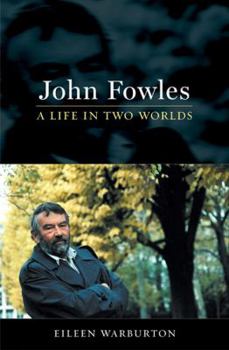
John Fowles: A Life in Two Worlds


Select Format
Select Condition 
Book Overview
Celebrated and applauded as one of the most seductive storytellers of the late twentieth century, a magician of the English language, a pioneer of postmodern sensibility, and the stylistic inspiration for a generation of writers and poets, John Fowles burst from obscurity in 1963 with the spectacular debut of his first novel, The Collector. Over the next two decades, the books rolled out: the astonishing psychological mystifications of The Magus, the haunting Victorian love story of The French Lieutenant's Woman, the pithy existentialist philosophy of The Aristos, the poignant short stories of The Ebony Tower, the transforming memory journey of Daniel Martin, the sizzling parable of Mantissa, the seventeenth-century religious puzzle of A Maggot, and a host of flawless dramatic translations and penetrating essays. The appearance of each of Fowles's romantic and fiercely intellectual works became a major literary event.
Format:Hardcover
Language:English
ISBN:0670032832
ISBN13:9780670032839
Release Date:March 2004
Publisher:Viking Adult
Length:528 Pages
Weight:2.12 lbs.
Dimensions:9.6" x 1.7" x 6.5"
Customer Reviews
4 ratings
Fowling Piece
Published by Thriftbooks.com User , 20 years ago
So, you'll know that John Fowles used to hunt a lot of birds until his eyesight went bad after having read this book. You'll also know all sorts of minutiae and what not about his private life and relations with others, particularly females. Many biographies err on the side of over-psychoanalysing the author. This one, or so it seems to me, errs a tad much on the side of caution in this regard. There are some good anecdotes: Particularly the pilgrimage of a pot-smoking Martin Amis and his topless girlfriend to visit the nonplussed Fowles, but somewhow one wants more than the very competenty documented story of his somewhat humdrum outer life.-I mean, one wants at least a little speculation as to his inner world. I think the most insightful bit I read here was a quote from Fowles's diary regarding how every author is the Prospero immersed in the magical world of his creation. What I would recommend to any reader searching for deeper insight is simply to go back and read his books, particularly The Magus (preferably after rereading The Tempest.)---His inner life is all THERE.-This biography supplies the, not too suprising, real world correlations to the characters and situations therein. Ultimately, this biography is very fine and competent. But perhaps a bit too fine and competent. I wish Ms. Warburton would have put herself on the line a bit more, offered a few of her own speculations, perhaps been a bit more like Fowles himself.
Solid and sobering
Published by Thriftbooks.com User , 21 years ago
Fans of John Fowles's towering mid-century novels have had to wait a long time for the first biography of this shy and enigmatic man. Most active as a published author between 1960 and 1980, today Fowles may be better known to the general public through the movies that were made of his books -- one good ("The French Lieutenant's Woman"), one mediocre ("The Collector"), and one execrable (the little seen and little known "The Magus") -- than by the marvelous, enthralling books themselves. The "two worlds" referred to in the title of this bio may be viewed as multiple dichotomies: his native England versus Greece where he taught school on the island of Spetsai and which inspired "The Magus"; his lower middle-class upbringing versus Oxford schooling and high literary art crowd/academia that uneasily embraced him; his brushes with Hollywood versus the tiny Dorset seacoast town of Lyme Regis where _The French Lieutenant's Woman_ takes place and where he has lived most of his adult life; his faithful 37-year marriage to Elizabeth Christy versus the adulterous affair from which it sprang (she was unhappily married when they met) . . . and versus the many fantasy affairs of the mind he carried on with other women real and created. This biography is about as "authorized" as one can get: Warburton was allowed full access to Fowles's voluminous journals, dating from 1950 to the early 1990s and the letters of John and Elizabeth Fowles. Fowles also gave the biographer many interviews and encouraged the people who had known him throughout his life to speak freely. Yet it hardly reads as hagiography; this is also about as "warts-and-all" as an authorized bio by an admiring reader can get. The early struggle to write was hard; fame was a poisoned apple; and ill health and depression plagues the novelist's recent life. Fowles misremembers stories, colors up his past in memory, but readily admits to doing so when faced with contrary evidence. (In fact, the discerning Fowles reader will remember he says as much as the narrator of TFLW.) The author bravely put the worst of his past on the line for his biographer, and one can only admire the courage of the one and the fairness of the other. This is not a "critical literary" bio -- Warburton notes connections and influences, but rarely spends more than a few pages describing or dissecting the works; it's a story of a complex life. There are plenty of tidbits to please the longtime fan. In 1975 Fowles wanted Helen Mirren to play his French Lieutenant's Woman (what a Sarah she would have made!). As soon as his first book made him notable, he looked forward to attacking writers he thought overrated, such as Iris Murdoch, but was too polite to do so once he met her. Somewhere there's a 531-page manuscript of a thriller called _The Device_, aka _Somebody's Got To Do It_, that Fowles wrote right after TFLW. Elizabeth Fowles was not only a muse and inspiration for many of the classic female characters in his books, but al
Deep Views into the Inner Life of the Writer
Published by Thriftbooks.com User , 21 years ago
Anyone who is a writer or wants to write would do well to read this biography. The book will also appeal to fans of John Fowles's novels, screenplays, translations, essays and poems. Seldom has a biographer of a writer had access to more material. Mr. Fowles made it his habit to make extensive daily notes about his life and his thoughts that could be turned into writing. As a result, Ms. Warburton is able to make connections between experiences, thoughts, drafts, hopes and characters all the way into final manuscripts and screenplays. Such references are immensely interesting and rewarding. The book contains so many such connections that you will feel as though you know works that you have not even glimpsed. Naturally, a side benefit of reading this book is to know which of John Fowles's works should be on your nightstand. The book is remarkably candid about Mr. Fowles as a man. Like many writers, he isn't as much of a personal giant as he is a literary figure. The background concerning his relationships with women and his first wife don't cast him in a very favorable light . . . yet it's important because his wife was a source for some of his most memorable characters and someone who played an important role in editing his earliest novels. As someone who writes nonfiction books, I found deep insights into the methods and processes that proved to be most helpful to Mr. Fowles. I was impressed by Ms. Warburton's sensitivities in this area. Be aware that his story contains many delicious ironies and much personal pain. Truth is indeed often stranger than fiction, even the often unusual fiction of John Fowles.
Deeper appreciation of Fowles
Published by Thriftbooks.com User , 21 years ago
John Fowles is one of the towering figures of 20th century fiction. He has not written many novels. But those that he did often garnered huge acclaim from a mass audience, as well as positive critiques from literary analysts. But if you are a fan, you might ask, "How did he do this?" (And if you aren't, why are you reading this?) To answer this, Warburton has given us an exhaustively researched biography, spanning his childhood in 1930s Britain to now. She had access to Fowles and his family, and also his original notes. This is reflected in the book's copious footnotes.The book itself can make for uncomfortable reading in the first half, before Fowles' "Collector" was published. Uncomfortable because it describes the daily struggles of Fowles to express himself. Nothing was inevitable. The many tortuous turns and the often financially straitened circumstances he was forced into. Warburton also gives us views into British society as it existed in those years, when class was such a distinguishing characteristic.Readers might contrast Fowles' experiences, and his wait till his mid 30s before success with that of, say, the polymath Isaac Asimov, who published as a teenager and then went on to produce over 300 books.Warburton strives to show the depth of Fowles' thoughts during those early years. And how these became reinterpreted in his novels. Indeed, after reading her efforts, you might be well served by re-reading Collector or his other works, for a deeper look at how Fowles worked his life experiences into his novels.
Copyright © 2026 Thriftbooks.com Terms of Use
| Privacy Policy | Do Not
Sell/Share My Personal Information | Cookie Policy | Cookie Preferences | Accessibility Statement
ThriftBooks® and the ThriftBooks® logo are registered trademarks of Thrift Books Global, LLC
ThriftBooks® and the ThriftBooks® logo are registered trademarks of Thrift Books Global, LLC
