


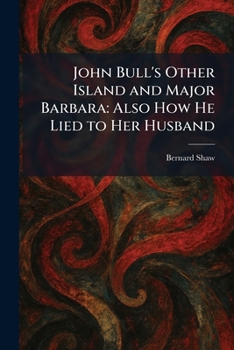
John Bull's Other Island and Major Barbara: Also How He Lied to Her Husband

Select Format
Select Condition 
Book Overview
This collection brings together three distinct works by the celebrated playwright George Bernard Shaw, showcasing his sharp wit and deep engagement with the social and political questions of his era. "John Bull's Other Island" explores the complex relationship between England and Ireland through the eyes of two business partners, offering a satirical look at national character and colonial politics. "Major Barbara" remains one of Shaw's most provocative plays, delving into the morality of wealth and the paradoxes of philanthropy through the conflict between a Salvation Army officer and her millionaire father, an arms manufacturer.
The volume also includes the brief but amusing one-act play "How He Lied to Her Husband", a clever farce that parodies the conventions of romantic drama. Together, these works illustrate Shaw's mastery of the "play of ideas," where intellectual debate and moral inquiry are woven into compelling theatrical narratives. These plays continue to be studied and performed for their enduring insights into capitalism, religion, and the human condition.
This work has been selected by scholars as being culturally important, and is part of the knowledge base of civilization as we know it. This work was reproduced from the original artifact, and remains as true to the original work as possible. Therefore, you may see the original copyright references, library stamps (as most of these works have been housed in our most important libraries around the world), and other notations in the work.
This work is in the public domain in the United States of America, and possibly other nations. Within the United States, you may freely copy and distribute this work, as no entity (individual or corporate) has a copyright on the body of the work.
As a reproduction of a historical artifact, this work may contain missing or blurred pages, poor pictures, errant marks, etc. Scholars believe, and we concur, that this work is important enough to be preserved, reproduced, and made generally available to the public. We appreciate your support of the preservation process, and thank you for being an important part of keeping this knowledge alive and relevant.
Related Subjects
DramaCustomer Reviews
ThriftBooks ® and the ThriftBooks ® logo are registered trademarks of Thrift Books Global, LLC
