


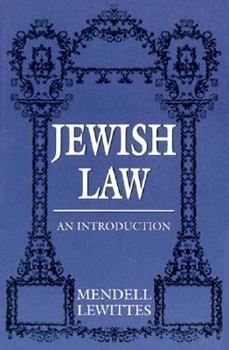
Jewish Law: An Introduction


To learn more about Rowman & Littlefield titles please visit us at www.rowmanlittlefield.com. This description may be from another edition of this product.
Format:Paperback
Language:English
ISBN:1568213026
ISBN13:9781568213026
Release Date:September 1994
Publisher:Jason Aronson, Inc.
Length:298 Pages
Weight:0.85 lbs.
Dimensions:8.2" x 0.8" x 7.1"
Related Subjects
Education & Reference History Judaism Law Religion Religion & Spirituality Sacred Writings Theology WorldCustomer Reviews
3 ratings
A good Modern Orthodox view of Halakhah
Published by Thriftbooks.com User , 19 years ago
Mendell Lewittes, a RIETS ordained Modern Orthodox Rabbi, has written a concise book on the development of halakhah ("Jewish law"), covering everything from the Torah to the Tanya, from the Zohar to Zionism. The book starts with the traditional view of Abraham, Moses, and the revelation by God to Moses at Mount Sinai. The rationale for accepting the mitzvot as binding, and as the source for all Jewish law, is discussed in depth, and illuminated by generous, albeit uncritical, quoting from our tradition's greatest sages. The importance of the Oral Law as well as the Written law is given a clear treatment, and is illustrated by demonstrating the development of early schisms in Judaism - the split between the Pharisees (progenitors of rabbinic Jews) and Sadducees (who rejected the Oral law). From here, the book moves into the era of the Tannaim and the Mishnah, and the development of the Talmud. Further topics include the development of the Gezerah, the Takkanah ("legal ordinance"), and Minhag ("custom"). From the Rishonim to the Acharonim, Lewittes tells the story of Ashkenazi and Sephardi rabbis who worked to reconcile Talmudic law with their changing world, and shows us the development of the many codes of Jewish law, particularly the Shulchan Aruch. Perhaps the most interesting part of this work lies in the discussion of the development of the Chasiddic movement, and the response of the mainstream Jewish community to the Chassids. Covering the most controversial part of Jewish history, we are then exposed to the effects of the Emancipation and Haskalah (Enlightenment movement), which set the stage for the development of the modern Jewish denominations, Orthodox, Conservative, and Reform Judaism. Unfortunately, makes an unprofessional and untenable jab at Conservative Jews when he states that Rabbi Isaac Klein's A Guide to Jewish Religious Practice is not a code of Jewish law. He comes to this conclusion through circular reasoning, a flaw which he only demonstrates when discussing non-Orthodox Jews. Lewittes claims that a code of Jewish law is a code that is accepted as halakhic by observant Jews. Since (he claims) observant Jews don't accept Klein's code, it therefore isn't a code at all. He only can force himself to reach this conclusion by defining any genuinely observant Jew as Orthodox, therefore concluding that all non-Orthodox Jews are not observant (a falsehood, and also an ad homenim attack.) Ironically, many of his interpretations of Jewish law are in line with that of Conservative rabbis of the mid 1950s, and some of his views on celebrating the existence of the modern State of Israel are rejected by most Orthodox Jews, and accepted only by Conservative Jews. A useful feature of this book is the parallel structure of the chapters. Each successive chapter covers a given time period, and within each chapter it covers not only Ashkenazi history, but also Sephardi history. Paragraph by paragraph we get to see how different Jewis
Solid and reliable.
Published by Thriftbooks.com User , 26 years ago
Mendell Lewittes, a member of Yeshiva University's very first graduating class (1932) and a rabbi who served, it seems, all over North America for 35 years, here provides an excellent introductory overview of the history and development of Halakha. Beginning at the beginning (the creation of man), Rabbi Lewittes places the foundation of Jewish law firmly on the giving of divine commandments (mitzvot). The development of Jewish law itself essentially begins at Sinai (though with the recognition that some specifically Jewish mitzvot had been given prior to this time); the meaning of Halakha is discussed and its integration with human life expounded. The reader is then led carefully through the Written Torah and the Oral Torah, the eventual redaction of the Talmud, and the history of Halakha up to and including the Shulchan Aruch. Four closing chapters deftly analyze four modern "challenges" to Halakha: Hasidism; Reform; modern science and medical practice; and Zionism. An epilogue presents a few views of Rabbi Lewittes's own about the direction Halakha should take from here, arguing among other things that the Modern Orthodox approach is capable of both remaining true to Tradition and adapting it to modern needs. Throughout his exposition, Rabbi Lewittes maintains a firmly Maimonidean-rationalist outlook, striking just the right balance between "The mitzvot _do_ make rational sense" and "Jews are required to keep them anyway (when possible), even though they may not make sense _to us_ right at the moment." Insisting with the Rambam that Jews are absolutely not required to believe anything that does violence to human reason (and, indeed, how could _any_ mitzvot be in principle unintelligible if they were given by a perfect Intelligence Who understands Himself?), Rabbi Lewittes also clearly recognizes the limitations of the human intellect and the need for a foundation of inviolable divine commands in order to forestall rationalization. The result is a fine and careful exposition that never ducks difficult questions, never fudges a point for the sake of making things easy for the lazy reader, and yet will repay the closest reading by anyone genuinely interested in what Halakha says and how it works. This book belongs on the shelf of anyone who wants to learn more about Jewish law.
Solid and reliable.
Published by Thriftbooks.com User , 26 years ago
Mendell Lewittes, a member of Yeshiva University's very first graduating class (1932) and a rabbi who served, it seems, all over North America for 35 years, here provides an excellent introductory overview of the history and development of Halakha.Beginning at the beginning (the creation of man), Rabbi Lewittes places the foundation of Jewish law firmly on the giving of divine commandments (mitzvot). The development of Jewish law itself essentially begins at Sinai (though with the recognition that some specifically Jewish mitzvot had been given prior to this time); the meaning of Halakha is discussed and its integration with human life expounded. The reader is then led carefully through the Written Torah and the Oral Torah, the eventual redaction of the Talmud, and the history of Halakha up to and including the Shulchan Aruch. Four closing chapters deftly analyze four modern "challenges" to Halakha: Hasidism; Reform; modern science and medical practice; and Zionism. An epilogue presents a few views of Rabbi Lewittes's own about the direction Halakha should take from here, arguing among other things that the Modern Orthodox approach is capable of both remaining true to Tradition and adapting it to modern needs.Throughout his exposition, Rabbi Lewittes maintains a firmly Maimonidean-rationalist outlook, striking just the right balance between "The mitzvot _do_ make rational sense" and "Jews are required to keep them anyway (when possible), even though they may not make sense _to us_ right at the moment." Insisting with the Rambam that Jews are absolutely not required to believe anything that does violence to human reason (and, indeed, how could _any_ mitzvot be in principle unintelligible if they were given by a perfect Intelligence Who understands Himself?), Rabbi Lewittes also clearly recognizes the limitations of the human intellect and the need for a foundation of inviolable divine commands in order to forestall rationalization.The result is a fine and careful exposition that never ducks difficult questions, never fudges a point for the sake of making things easy for the lazy reader, and yet will repay the closest reading by anyone genuinely interested in what Halakha says and how it works. This book belongs on the shelf of anyone who wants to learn more about Jewish law.
Copyright © 2026 Thriftbooks.com Terms of Use
| Privacy Policy | Do Not
Sell/Share My Personal Information | Cookie Policy | Cookie Preferences | Accessibility Statement
ThriftBooks® and the ThriftBooks® logo are registered trademarks of Thrift Books Global, LLC
ThriftBooks® and the ThriftBooks® logo are registered trademarks of Thrift Books Global, LLC
