


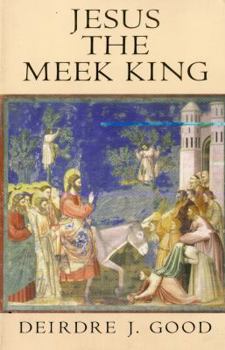
Jesus the Meek King

Select Format
Select Condition 
Book Overview
A full and contextual understanding of Jesus as the meek king of Matthew's Gospel. An epilogue charts the history of "meek" in Bible translations from Tyndale to the present.
Format:Paperback
Language:English
ISBN:1563382849
ISBN13:9781563382840
Release Date:June 1999
Publisher:Trinity Press International
Length:144 Pages
Weight:0.63 lbs.
Dimensions:0.4" x 5.5" x 8.5"
Customer Reviews
1 rating
A Prayer and Insight into the Gospel of Matthew
Published by Thriftbooks.com User , 26 years ago
Jesus the Meek King by Deirdre J. Good This book is an exegesis of two bible verses within their cultural contexts, an insight into the Gospel of Matthew and a prayer. Let me explain. The premise of the book is that our appreciation of Scripture is enhanced by understanding the context in which it was written by analysis of contemporaneously influential texts. We are introduced to relevant classical Greek texts of Aristotle, Plato and Isocrates; Hellenistic texts of Plutarch, the Stoics, Theophrastus, the Epistle of Aristeas and Pseudo-Pythagoreans; Jewish texts from the Pentateuch, Josephus, the Psalms, Zechariah, 4 Maccabees, Philo and the Dead Sea Scrolls; and the Christian texts of the Gospel of Thomas, Paul, Eusebius, the Desert Fathers, First Clement, the Didache and the Epistle to Diognetus. Alone the breadth and variety of these references make the book an intellectual and spiritual feast. Preparatory chapters educate the reader on the meaning of praus [meek] and kingship in their Hellenistic context. Praotes (meekness) is a virtue and a warrant for control of others. We are shown this in Philo's description of Moses and Aristotle's description of the virtue praus as being the mean between anger and lack of spirit. Praus behavior is illuminated by examples from 4 Maccabees (the story of the 7 brothers and their mother), Plutarch, Paul and the Epistle to Diognetus. With regard to Hellenistic kingship, we are introduced to sources for the concept of ideal king and learn that praotes is a valued royal quality. In the letter of Aristeas, a praus king is compassionate to the enemy; according to Theophrastus, the true king rules with the scepter and not the sword; according to 2 Maccabees, the high priest Onias is envisioned by Judas Maccabeus as modest and praus. We also learn of ruler cults before and after Alexander. With this background, we are prepared to study Matt 11:28-29: Come to me, all who labor and are heavy laden, and I will give you rest. Take my yoke upon you, and learn from me; for I am praus and lonely in heart, and you will find rest for your souls. Deirdre argues that Matthew presents Jesus as a praus king who, in accordance with Hellenistic and Jewish thinking, is God's son. While Sirach 51 at first blush appears to bear a striking resemblance to these verses, Deirdre distinguishes the wisdom tradition in Sirach and argues that internal warrants describe Jesus as king and son and points to an external warrant in 1 Maccabees that connects monarchy and servitude with specific yoke language evocative of Matt 11:28-29. In addition, 3 external warrants support Deirdre's thesis. They are the Greek version of Zechariah 9:9, quoted in Matt 21:4-5; saying 90 of the Gospel of Thomas; and the Sibylline Oracles, which quote and elaborate on Matthew's quotation from Zechariah. Deirdre shows multiple internal warrants for her thesis. The demeanor of other kings in the Gospel contrasts
Copyright © 2026 Thriftbooks.com
Terms of Use | Privacy Policy | Do Not Sell/Share My Personal Information | Cookie Policy | Cookie Preferences | Accessibility Statement
ThriftBooks ® and the ThriftBooks ® logo are registered trademarks of Thrift Books Global, LLC
ThriftBooks ® and the ThriftBooks ® logo are registered trademarks of Thrift Books Global, LLC
