


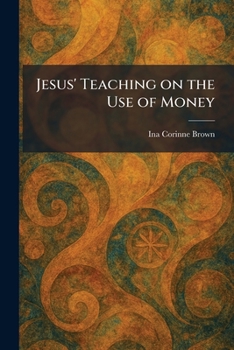
Jesus' Teaching on the Use of Money

"Jesus' Teaching on the Use of Money" is a compelling examination of the New Testament's perspective on material wealth and financial ethics. This work delves into the core principles taught by Jesus regarding the possession, distribution, and spiritual impact of money. By analyzing specific parables and direct instructions found in the Gospels, Ina Corinne Brown highlights the inherent tension between worldly accumulation and the demands of a life dedicated to faith and service.
The book serves as both a historical study of first-century economic contexts and a timeless guide for individuals seeking to align their financial practices with Christian values. It covers essential themes such as stewardship, the dangers of greed, and the moral obligation to care for the marginalized. The text explores how the use of money reflects one's character and commitment to spiritual growth. This insightful volume remains a valuable resource for students of theology, church leaders, and lay readers interested in the ethical intersections of faith and finance. Through its rigorous yet accessible analysis, "Jesus' Teaching on the Use of Money" continues to offer profound insights into one of the most practical and challenging aspects of the Christian life.
This work has been selected by scholars as being culturally important, and is part of the knowledge base of civilization as we know it. This work was reproduced from the original artifact, and remains as true to the original work as possible. Therefore, you may see the original copyright references, library stamps (as most of these works have been housed in our most important libraries around the world), and other notations in the work.
This work is in the public domain in the United States of America, and possibly other nations. Within the United States, you may freely copy and distribute this work, as no entity (individual or corporate) has a copyright on the body of the work.
As a reproduction of a historical artifact, this work may contain missing or blurred pages, poor pictures, errant marks, etc. Scholars believe, and we concur, that this work is important enough to be preserved, reproduced, and made generally available to the public. We appreciate your support of the preservation process, and thank you for being an important part of keeping this knowledge alive and relevant.
Customer Reviews
ThriftBooks ® and the ThriftBooks ® logo are registered trademarks of Thrift Books Global, LLC
