


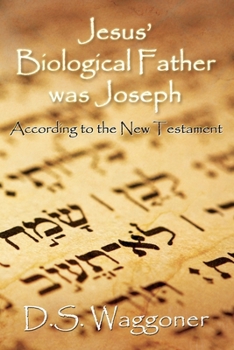
Jesus' Biological Father was Joseph: According to the New Testament
No Customer Reviews

Select Format
Select Condition 
Book Overview
Jews have claimed for nearly two-thousand years that Jesus had a biological father, if he existed at all. Until now, they have been unable to produce evidence of Jesus' natural paternity, though, and without the invention of the Internet, arguably, no evidence could ever be produced. However, with the invention of the Internet, one Jewish argument has surfaced which can be argued from ancient manuscripts of the New Testament itself. This defense of the Jewish argument that the messiah must have a biological father traced to King David through King Solomon and that purportedly, the Gospel of Matthew has, is that the early church manuscripts of the Gospels of Matthew and Luke are worded so ambiguously, that the Gospels did not explicitly describe Jesus as virgin birthed, but rather their writings could be interpreted that the Jewish author of the Gospel of Matthew described Jesus as a biological son of Joseph. In order to observe the possibility of any legitimacy of this rumor, one need only look to the discovered Greek New Testament manuscripts, which for the most part, lay proverbially chained under lock and key behind church walls where Jews could not read them, for nearly two thousand years. Until now, thanks to ... Martin Luther. Yes, in the English, Mary is described as a "virgin". Matthew's Gospel wasn't written in English, though, and when we search back into the Greek, a highly controversial Christmas story emerges. Here's the "natural birth" spin we now hear, which can flip the birth narratives in order to discover the New Testament describing Jesus as the biological (natural) son of Joseph, David and Abraham (through Solomon, in Matthew 1:1 in the Greek), rather than "by adoption". Compare Matthew 1:16 to Exodus 6:20. Both Moses' genealogy and Jesus' genealogy indicate that the father wedded the mother, and she gave birth. Additionally, neither Moses nor Jesus is ever said to have been begotten by their father. In other words, both Moses and Jesus are said to have been born of a woman, and additionally, neither men are ever described as begotten of a man. Are these texts indicating that both men were "virgin birthed"? Or neither? Why wouldn't a Jew recognize the glaring Mosaic wording of this text? Additionally, the English word "virgin" is a translation from the Greek word "parthenos". Interestingly, this same Greek word, Parthenos, was used in the Greek Septuagint of Genesis 34:3 to describe a young unwed woman ... who had already had intimate relations with a man. Yes, who had already had intimate relations with a man. So in order to explicitly describe Mary as a "chaste" ... "betrothed" woman, who had never had intimate relations with a man, the Gospel authors would have needed to add the Greek word "hagnos", which is translated as "chaste", making their description of Mary as a "chaste betrothed" woman, who conceived out of wedlock. This Greek phrase "hagnos parthenos" is used in the New Testament to describe a chaste betrothed woman, in 2 Corinthians 11:1-2. This Greek term, shockingly though, is never once used to describe Mary. Why not? Mary, 100% of the time, is merely said to be a parthenos, and the idea of her being "hagnos" (chaste), is scandalously avoided every single time. Whether you are arguing for or against the Virgin Birth doctrine, you are sure to find a few gems in this tiny book. Cover to cover controversy There is one intended flaw inserted within this work, and if you find it, leave it in the reviews, including the page number, chapter, and verse
Format:Paperback
Language:English
ISBN:B089CSNG2B
ISBN13:9798649541497
Release Date:May 2020
Publisher:Independently Published
Length:128 Pages
Weight:0.40 lbs.
Dimensions:0.3" x 6.0" x 9.0"
Customer Reviews
0 rating
Copyright © 2026 Thriftbooks.com
Terms of Use | Privacy Policy | Do Not Sell/Share My Personal Information | Cookie Policy | Cookie Preferences | Accessibility Statement
ThriftBooks ® and the ThriftBooks ® logo are registered trademarks of Thrift Books Global, LLC
ThriftBooks ® and the ThriftBooks ® logo are registered trademarks of Thrift Books Global, LLC
