


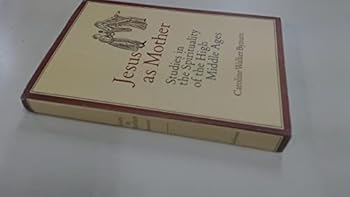
Jesus as mother: Studies in the spirituality of the High Middle Ages (Publications of the Center for Medieval and Renaissance Studies, UCLA)
(Part of the Center for Medieval and Renaissance Studies, UCLA Series)

Select Format
Select Condition 
Book Overview
From the Introduction, by Caroline Walker Bynum: The opportunity to rethink and republish several of my early articles in combination with a new essay on the thirteenth century has led me to consider... This description may be from another edition of this product.
Format:Hardcover
Language:English
ISBN:0520041941
ISBN13:9780520041943
Release Date:January 1982
Publisher:Univ. of California Press
Length:280 Pages
Weight:1.35 lbs.
Customer Reviews
3 ratings
Can't Judge a Book by Its Title
Published by Thriftbooks.com User , 17 years ago
Those going to this book for traditional feminist theology may come away disappointed. It can perhaps be understood more as a critique of certain strains of feminism than an endorsement. Observe how Bynum, perhaps the most respected medievalist in the United States, sheds considerable doubt on some standard Seminary mythology: "It was not women who originated female images of God.... such language is in no way the special preserve of female writers... There is no reason to assert, as some have done, that the theme of the motherhood of God is a 'feminine insight.' Moreover it is not at all clear, although many scholars assume it, that women are particularly drawn to feminine imagery" (140). Bynum goes on to explain that in the Middle Ages, feminine God images were occasionally employed by men, specifically abbots, "because they needed to supplement their image of authority with that for which the maternal stood" (154). Interestingly enough, women writers used such imagery much more rarely, if at all. "Jesus as Mother" can therefore be contextually explained as a response to leadership challenges in medieval monasteries, not as a long-suppressed feminine ethos: "The theme of God's motherhood is a minor one in all writers of the high Middle Ages except Julian of Norwich. Too long neglected or even repressed by editors and translators, it is perhaps now in danger of receiving more emphasis than it deserves" (168). Instead, what stands out in the writings of twelfth and thirteenth century nuns of Helfta is their theological orthodoxy: "Unlike the God of the fourteenth-century mystics (Julian of Norwich or Eckhart , for example), the God of [Gertrude's] visions is tough... There appears to have been a moment in the thirteenth century at which the growing sense of man's likeness to God - expressed not only in the later medieval emphasis on Christ's humanness and the rich variety of homey and natural metaphors for the divine but also in the new confidence about man's capacity for intimate union with God - was still balanced by older images of an awesome God, totally unlike man, who rules a universe... This thirteenth-century combination of likeness and unlikeness underlay the optimism and strength of the piety of Helfta" (255). Bynum's book, then, is in agreement with another medieval historian, Barbara Newman, who in another misleadingly titled book, "From Virile Woman to WomanChrist," wrote: "It was not because of their commitment to feminism, self-empowerment, subversion, sexuality, or 'the body' that [medieval woman] struggled and won their voices; it was because of their commitment to God" (p. 246).
"Proficient milk from the breasts of Christ"
Published by Thriftbooks.com User , 18 years ago
Shortly after Katharine Jefferts Schori was elected Presiding Bishop of the Episcopal Church in 2006, she gave a sermon in which she referred to "our mother Jesus." This caused gnashing of teeth in some Anglican circles, whose members accused her of appealing to "radical feminist theology." But in fact, as historian Caroline Walker Bynum demonstrated twenty-five years earlier in this wonderful and ground-breaking collection of essays, the feminization of Jesus (and occasionally of God the Father) wasn't unknown in 12th century Cistercian monastic writings. And no one can accuse these high middle age monks of radical feminist theology. Bynum's Jesus as Mother actually contains five erudite but enjoyably readable essays. They deal in one way or another with spirituality in the 12th and 13th centuries. The final essay, "Women Mystics in the Thirteenth Century: The Case of the Nuns of Helfta," is especially fine, and is long enough to be a short book in its own right. But the essay that's attracted the most attention is the fourth: "Jesus as Mother and Abbot as Mother: Some Themes in Twenfth-Century Cistercian Writing." In this carefully crafted and utterly nonpolemical essay, Bynum demonstrates that Cistercian models of community and leadership were frequently thought of in maternal terms, and these in turn were adapted from maternal metaphors to describe the nurturing and loving qualities of Jesus. The relationship between monk and abbot was often spoken of in mother-child terms, just as was the relationship between Christian and Christ. No 12th-century Cistercian would've thought the expression "our mother Jesus" unusual or heretical. On the contrary, he would've thought it nicely captured the essence of the Christian story. How marvelous that an all-male environment in a time too often referred to by us as the "dark ages" should've so enriched discourse about Jesus and God. Surely the "dark ages" have things to teach us. Readers who enjoy Jesus as Mother may want to take a look at more of Bynum's work. A particular favorite of mine is Holy Feast and Holy Fast: The Religious Significance of Food to Medieval Women. I look forward to reading her recently released (2007) Wonderful Blood.
Great scholarship
Published by Thriftbooks.com User , 18 years ago
A 'must have' for any feminist's library. I would have liked to have it in hardback though.
Copyright © 2025 Thriftbooks.com
Terms of Use | Privacy Policy | Do Not Sell/Share My Personal Information | Cookie Policy | Cookie Preferences | Accessibility Statement
ThriftBooks ® and the ThriftBooks ® logo are registered trademarks of Thrift Books Global, LLC
ThriftBooks ® and the ThriftBooks ® logo are registered trademarks of Thrift Books Global, LLC
