


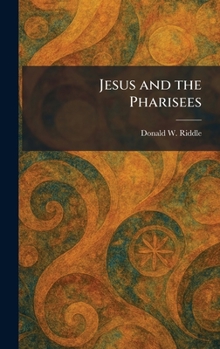
Jesus and the Pharisees

Select Format
Select Condition 
Book Overview
"Jesus and the Pharisees" offers a compelling historical investigation into one of the most significant and often misunderstood relationships in the New Testament. This work seeks to move beyond traditional caricatures to provide a nuanced portrait of the Pharisaic movement and its historical interactions with Jesus of Nazareth.
Donald W. Riddle examines the social, religious, and political landscape of first-century Palestine, analyzing the Pharisees not merely as theological opponents, but as a vital and influential group within Second Temple Judaism. By scrutinizing the Gospel narratives alongside contemporary Jewish sources, the author explores the points of convergence and conflict between Jesus's teachings and Pharisaic tradition. The book addresses critical questions regarding the Law, ritual purity, and the evolution of early Christian thought as it diverged from its Jewish roots.
This scholarly study remains an essential resource for readers interested in biblical history, the life of Jesus, and the development of early Christianity. It provides valuable insights into the complex dynamics of ancient Jewish life and the historical context that shaped the foundational texts of the Western tradition.
This work has been selected by scholars as being culturally important, and is part of the knowledge base of civilization as we know it. This work was reproduced from the original artifact, and remains as true to the original work as possible. Therefore, you may see the original copyright references, library stamps (as most of these works have been housed in our most important libraries around the world), and other notations in the work.
This work is in the public domain in the United States of America, and possibly other nations. Within the United States, you may freely copy and distribute this work, as no entity (individual or corporate) has a copyright on the body of the work.
As a reproduction of a historical artifact, this work may contain missing or blurred pages, poor pictures, errant marks, etc. Scholars believe, and we concur, that this work is important enough to be preserved, reproduced, and made generally available to the public. We appreciate your support of the preservation process, and thank you for being an important part of keeping this knowledge alive and relevant.
Customer Reviews
ThriftBooks ® and the ThriftBooks ® logo are registered trademarks of Thrift Books Global, LLC
