


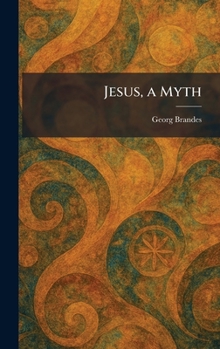
Jesus, a Myth

"Jesus, a Myth" is a provocative and scholarly investigation into the historical foundations of Christianity and the origins of its central figure. Written by the renowned critic Georg Brandes, this work explores the Christ Myth theory, meticulously questioning whether Jesus of Nazareth was a historical individual or a composite figure born from ancient mythological traditions and symbolic archetypes.
Brandes applies a rigorous literary and historical lens to the New Testament, analyzing the Gospels not as biographical records but as theological constructions. He examines the parallels between Christian narratives and earlier pagan myths, suggesting that the figure of Jesus served a specific cultural and psychological purpose in the ancient world. By highlighting contradictions within the biblical texts, Brandes challenges traditional theological assumptions and offers a rationalistic perspective on the development of early Christian faith.
This work stands as a significant contribution to the field of biblical criticism and early 20th-century secular thought. It remains an essential read for those interested in the philosophical debates surrounding the historicity of Jesus, the evolution of religious dogma, and the intersection of myth and history in Western civilization.
This work has been selected by scholars as being culturally important, and is part of the knowledge base of civilization as we know it. This work was reproduced from the original artifact, and remains as true to the original work as possible. Therefore, you may see the original copyright references, library stamps (as most of these works have been housed in our most important libraries around the world), and other notations in the work.
This work is in the public domain in the United States of America, and possibly other nations. Within the United States, you may freely copy and distribute this work, as no entity (individual or corporate) has a copyright on the body of the work.
As a reproduction of a historical artifact, this work may contain missing or blurred pages, poor pictures, errant marks, etc. Scholars believe, and we concur, that this work is important enough to be preserved, reproduced, and made generally available to the public. We appreciate your support of the preservation process, and thank you for being an important part of keeping this knowledge alive and relevant.
Customer Reviews
ThriftBooks ® and the ThriftBooks ® logo are registered trademarks of Thrift Books Global, LLC
