




Select Format
Select Condition 
Book Overview
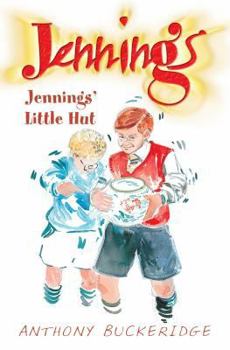
Supersonic hoo-hah Jennings and Darbishire watched with mounting horror. Earthquakes and landslides seemed to be happening before their eyes. The little hut was heaving like a thing possessed. 'Oh, fish-hooks ' breathed Jennings in dismay. 'He's smashing up the place like a bulldozer ' The woodland at Linbury Court becomes squatters' territory when Jennings comes up with the idea of building huts out of reeds and branches. Jennings and Darbishire are thrilled with their construction, which even includes a patented prefabricated ventilating shaft, a special irrigation drainage canal and a pontoon suspension bridge Gruesome hornswoggler But things can only go horribly wrong for Jennings when he is put in charge of Elmer, the treasured goldfish, and even worse when the Headmaster pays the squatters a visit. And if Jennings thinks that a game of cricket will be far less trouble, he's going to be knocked for six Rotten chizzler
Format:Paperback
Language:English
ISBN:0755113675
ISBN13:9780755113675
Release Date:January 2008
Publisher:House of Stratus, Incorporated
Length:210 Pages
Weight:0.58 lbs.
Dimensions:0.5" x 5.3" x 8.1"
Age Range:9 to 12 years
Grade Range:Preschool to Grade 12
Customer Reviews
1 rating
Mischief, muddles, mishaps
Published by Thriftbooks.com User , 17 years ago
This book is set in England in the 1950's. Jennings is in his third term at Linbury Court Preparatory School and he is nearly eleven years old. Linbury is a boy's boarding school, and Jennings, and his friend Darbishire, are well know to the staff as sources of mischief, muddles and mishaps. Thanks to the winning talents of Mr. Carter, the boy's teacher, Mr. Pemberton-Oakes, the Headmaster, has been persuaded, against his better judgment, to allow the students to play near the pond. This is an area of marshy ground some distance from the school buildings. Plenty of reeds grow there and Jennings and Darbishire were the first to think of building a hut out of the available materials. Soon all the boys were building huts, each one with individual and highly original features. Jennings and Darbishire's hut has a duel purpose ventilating shaft/periscope made out of a discarded metal pipe. It also has a small inner room where Darbishire can sit and invent new ideas for the hut. All the boys are under strict instructions not to dirty their uniforms too much and of course the temptations of the muddy pond are great. But fate seems to be most against Jennings and Darbishire and soon they are reeling from one 'terrible bish' to another. Can Jennings survive his third term or will it all end in disaster? This is the third book in the twenty-five volume Jennings series. The first book was Jennings Goes To School (1950) and the second was Jennings Follows a Clue (1951). This third book, which was also first published in 1951, is a very entertaining novel. It has a plot that twists and turns and is full of surprises. The second half of the book is particularly good and it is easy to see how this series became a popular classic in children's fiction. Buckeridge writes in a light humorous style and it is clear that Jennings lives in a safe, caring environment. There is no bullying from students or teachers and while corporal punishment is a reality and possibility Jennings manages to skate around it. Homesickness also seems to be absent, although Jennings did suffer from that in the first book. In this difficult world where crimes are news every night of the week it is difficult to know whether it is better to protect children or give them a strong dose of reality. Buckeridge has definitely chosen to shield his readers and the result is a funny but artificially rosy world. Jennings is of course memorable as that wide-awake student whose active imagination leads him into trouble. Darbishire is a masterful representation of the small, quiet studious type who is definitely not successful on the sports ground. Mr. Wilkins also stands out as the blustering, short-tempered algebra teacher who, under guidance from Mr. Carter, sees reason in the end. Although this book was written in the 1950's suprisingly little in it has dated. Children, I think, remain basically the same, and most modern kids should enjoy this book. The Jennings books were
Copyright © 2026 Thriftbooks.com
Terms of Use | Privacy Policy | Do Not Sell/Share My Personal Information | Cookie Policy | Cookie Preferences | Accessibility Statement
ThriftBooks ® and the ThriftBooks ® logo are registered trademarks of Thrift Books Global, LLC
ThriftBooks ® and the ThriftBooks ® logo are registered trademarks of Thrift Books Global, LLC
