


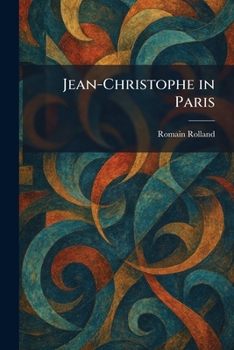
Jean-Christophe in Paris

"Jean-Christophe in Paris" is the compelling second installment of Romain Rolland's epic masterpiece, following the journey of the titular protagonist, Jean-Christophe Kraft. After escaping the oppressive atmosphere of his German homeland, the brilliant young musician arrives in Paris, the cultural heart of Europe. This volume explores his struggles to find his place within the complex and often superficial social and artistic circles of the city. Rolland meticulously depicts the clash between Jean-Christophe's uncompromising idealism and the decadent realities of Parisian life.
Through the eyes of a disillusioned outsider, the work offers a profound critique of early 20th-century French culture, music, and politics. Central to the narrative is the transformative friendship between Jean-Christophe and the gentle, sensitive Olivier, representing a symbolic union of the German and French spirits. "Jean-Christophe in Paris" is not merely a story of individual growth but a vast panorama of European intellectual life. Romain Rolland's lyrical prose and deep psychological insight earned him the Nobel Prize in Literature, making this series a cornerstone of modern literary history. It remains a powerful exploration of the artist's soul and the universal quest for truth and creative integrity.
This work has been selected by scholars as being culturally important, and is part of the knowledge base of civilization as we know it. This work was reproduced from the original artifact, and remains as true to the original work as possible. Therefore, you may see the original copyright references, library stamps (as most of these works have been housed in our most important libraries around the world), and other notations in the work.
This work is in the public domain in the United States of America, and possibly other nations. Within the United States, you may freely copy and distribute this work, as no entity (individual or corporate) has a copyright on the body of the work.
As a reproduction of a historical artifact, this work may contain missing or blurred pages, poor pictures, errant marks, etc. Scholars believe, and we concur, that this work is important enough to be preserved, reproduced, and made generally available to the public. We appreciate your support of the preservation process, and thank you for being an important part of keeping this knowledge alive and relevant.
Customer Reviews
ThriftBooks ® and the ThriftBooks ® logo are registered trademarks of Thrift Books Global, LLC
