


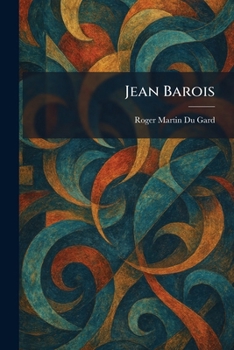
Jean Barois

Select Format
Select Condition 
Book Overview
"Jean Barois" is a monumental novel that captures the intellectual and spiritual conflicts of early 20th-century France. The narrative follows the life of Jean Barois, an individual torn between his strict Catholic upbringing and the beckoning call of scientific rationalism. As he abandons his faith to embrace a life of reason and secularism, the book meticulously documents his personal transformation alongside the social upheavals of the time.
The story is deeply intertwined with the Dreyfus Affair, providing a dramatic backdrop for the ideological battles that divided French society. Through a distinctive style that incorporates dialogue and historical documents, Roger Martin du Gard explores the profound tension between science and religion, the nature of conviction, and the weight of tradition.
As "Jean Barois" navigates the complexities of marriage, friendship, and political activism, the work delves into the psychological and philosophical challenges of modern existence. This masterpiece of French literature, written by a Nobel Prize-winning author, serves as both a compelling character study and a sweeping historical account of a generation in search of new foundations for morality and truth. It remains an essential work for those interested in the history of ideas and the perennial struggle of the human spirit.
This work has been selected by scholars as being culturally important, and is part of the knowledge base of civilization as we know it. This work was reproduced from the original artifact, and remains as true to the original work as possible. Therefore, you may see the original copyright references, library stamps (as most of these works have been housed in our most important libraries around the world), and other notations in the work.
This work is in the public domain in the United States of America, and possibly other nations. Within the United States, you may freely copy and distribute this work, as no entity (individual or corporate) has a copyright on the body of the work.
As a reproduction of a historical artifact, this work may contain missing or blurred pages, poor pictures, errant marks, etc. Scholars believe, and we concur, that this work is important enough to be preserved, reproduced, and made generally available to the public. We appreciate your support of the preservation process, and thank you for being an important part of keeping this knowledge alive and relevant.
Customer Reviews
ThriftBooks ® and the ThriftBooks ® logo are registered trademarks of Thrift Books Global, LLC
