


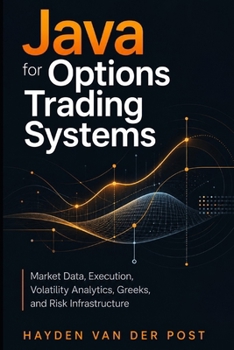
Java for Options Trading Systems: Market Data, Execution, Volatility Analytics, Greeks, and Risk Infrastructure

Java for Options Trading Systems is a practical guide to designing software architecture for options trading environments using Java. The book focuses on the core technical components behind modern trading systems, including market data handling, order execution workflows, volatility analytics, Greeks calculation, and real-time risk infrastructure.
Rather than treating options trading as a purely theoretical finance topic, this book approaches it as an engineering problem. Readers are introduced to the design patterns, data structures, service boundaries, and system architecture considerations needed to build reliable trading-related applications in Java.
Inside, the book explores how Java can be used to structure market data pipelines, model option contracts, process volatility inputs, calculate risk sensitivities, organize execution logic, and support monitoring and controls for fast-moving markets. It also discusses practical engineering concerns such as latency, concurrency, fault tolerance, modular design, testing, and maintainability.
Designed for software developers, quantitative developers, trading system engineers, and technically minded finance professionals, this book provides a structured foundation for building options-focused financial technology systems with Java.
Customer Reviews
ThriftBooks ® and the ThriftBooks ® logo are registered trademarks of Thrift Books Global, LLC
