


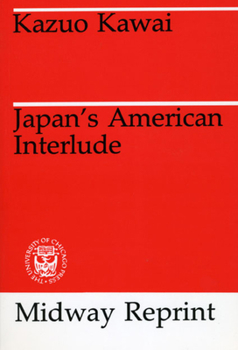
Japan's American Interlude

Select Format
Select Condition 
Book Overview
How did the Japanese themselves respond to the American occupation? How were the sweeping reforms--political, social, and economic--of SCAP's program received? How permanent was their effect, and why did some succeed and others fail completely? How successful in the long view was the democratization induced by MacArthur's "artificial revolution"? And what tendencies existing in fundamental Japanese attitudes and history might account for this peculiar success? The author, Japanese-born and educated in America, a political scientist and journalist, brings his unique experience and knowledge to bear on these questions. The result is a book which tells the story of the American occupation of Japan from the Japanese point of view.
Format:Paperback
Language:English
ISBN:0226427757
ISBN13:9780226427751
Release Date:December 1979
Publisher:University of Chicago Press
Length:266 Pages
Weight:0.65 lbs.
Dimensions:0.6" x 6.0" x 9.1"
Customer Reviews
1 rating
Excellent view from the other side
Published by Thriftbooks.com User , 20 years ago
This book holds an important place in history, as it was the first book that ever looked at the American occupation of Japan from 1946-1952 from the Japanese perspective. much of what Kawai wrote back in 1960 seems absurdly pessimistic about Japan's future, when he said of Japan "she can no longer hope to play a major independent role in world politics". The book features several incredible insights to the Japanese mind of the 1950's, including how the Japanese actually saw Hirohito, the new police and judicial system, the food America imported to feed the Japanese, and how the Japan initially started to recover. kawai believed that the occupation succeeded due to Japanese traditional pragmatism, a pragmatism whose temporary dismissal brought fourth WW2, in Kawai's mind. This book is made relevant for today's scholar by comparing the events of America's attempts at "nation-building" in 1945 Japan to America's "nation-building" of Iraq in 2005. We had finished the fighting in Japan, but have not yet done so in Iraq. The United States was woefully ignorant to the nutrition necessities of Japan, but knew exactly what to do in Iraq. In both places the American overseers were exceedingly careful about who would govern the country. Perhaps most importantly, we can learn from Kawai's slight pessimism on 1960 Japan, and what it is like today, and remember it as an object lesson whenever one feels pessimistic on what is currently happening in Iraq, or even Afghanistan. In conclusion, Japan's American Interlude proved to be a very informative and valuable book for learning more about Japanese culture and the immediate aftermath of World War II. It is well-written, and full of information on what happened during America's occupation of Japan, The reader just has to remember that any pessimistic conclusions Kawai made when writing this book in 1960 are mostly disproved by time, not because Kawai did not know his subject. He just needed a crystal ball, or at least optimism, to truly stand out for the modern reader. That is the only sad thing about this work.
Copyright © 2026 Thriftbooks.com Terms of Use
| Privacy Policy | Do Not
Sell/Share My Personal Information | Cookie Policy | Cookie Preferences | Accessibility Statement
ThriftBooks® and the ThriftBooks® logo are registered trademarks of Thrift Books Global, LLC
ThriftBooks® and the ThriftBooks® logo are registered trademarks of Thrift Books Global, LLC
