


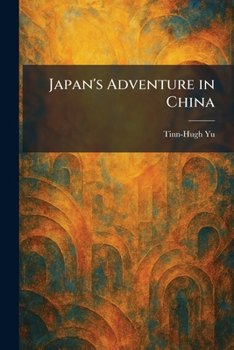
Japan's Adventure in China

Select Format
Select Condition 
Book Overview
"Japan's Adventure in China" offers a critical contemporary analysis of the escalating tensions and military engagements between Japan and China during the late 1920s. Written from a perspective deeply engaged with the political landscape of the era, the work examines the motivations, strategies, and consequences of Japanese intervention in Chinese territories, particularly focusing on the events surrounding the Shantung intervention and the Tsinan Incident.
The author, Yu Tinn-Hugh, provides a detailed account of the diplomatic friction and the shifting balance of power in East Asia. The book serves as a vital historical document, capturing the anxieties of a nation facing external encroachment and the complexities of international law and territorial sovereignty. Readers interested in the roots of the Second Sino-Japanese War and the broader history of 20th-century Asian geopolitics will find this text indispensable. By documenting the socio-political climate of 1928, "Japan's Adventure in China" sheds light on the prelude to global conflict, offering insights into the ideological and military maneuvers that defined an era of profound transformation in the Far East.
This work has been selected by scholars as being culturally important, and is part of the knowledge base of civilization as we know it. This work was reproduced from the original artifact, and remains as true to the original work as possible. Therefore, you may see the original copyright references, library stamps (as most of these works have been housed in our most important libraries around the world), and other notations in the work.
This work is in the public domain in the United States of America, and possibly other nations. Within the United States, you may freely copy and distribute this work, as no entity (individual or corporate) has a copyright on the body of the work.
As a reproduction of a historical artifact, this work may contain missing or blurred pages, poor pictures, errant marks, etc. Scholars believe, and we concur, that this work is important enough to be preserved, reproduced, and made generally available to the public. We appreciate your support of the preservation process, and thank you for being an important part of keeping this knowledge alive and relevant.
Customer Reviews
ThriftBooks ® and the ThriftBooks ® logo are registered trademarks of Thrift Books Global, LLC
