


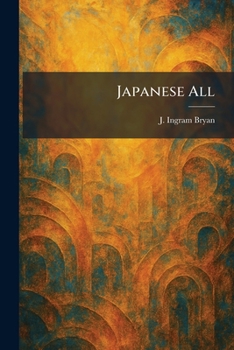
Japanese All

"Japanese All" offers a comprehensive and insightful examination of Japanese life and culture during the early 20th century. Written by J. Ingram Bryan, a noted scholar and long-term resident of Japan, the work serves as a window into the traditions, social structures, and evolving modern identity of the nation during a period of significant transition.
The book explores a wide array of topics, ranging from the intricacies of Japanese etiquette and domestic life to the broader strokes of national history, religion, and literature. Bryan's observations provide a nuanced perspective on the country's unique blend of ancient customs and rapid modernization. Through descriptive prose and thoughtful analysis, "Japanese All" delves into the character of the Japanese people, their art, their philosophy, and their aspirations on the global stage.
This work remains a valuable resource for those interested in the historical sociology of East Asia. It provides a vivid portrait of a nation, capturing the essence of Japanese civilization at a pivotal moment in its history. Readers will find a rich tapestry of cultural observations that continue to resonate for students of history and sociology alike.
This work has been selected by scholars as being culturally important, and is part of the knowledge base of civilization as we know it. This work was reproduced from the original artifact, and remains as true to the original work as possible. Therefore, you may see the original copyright references, library stamps (as most of these works have been housed in our most important libraries around the world), and other notations in the work.
This work is in the public domain in the United States of America, and possibly other nations. Within the United States, you may freely copy and distribute this work, as no entity (individual or corporate) has a copyright on the body of the work.
As a reproduction of a historical artifact, this work may contain missing or blurred pages, poor pictures, errant marks, etc. Scholars believe, and we concur, that this work is important enough to be preserved, reproduced, and made generally available to the public. We appreciate your support of the preservation process, and thank you for being an important part of keeping this knowledge alive and relevant.
Customer Reviews
ThriftBooks ® and the ThriftBooks ® logo are registered trademarks of Thrift Books Global, LLC
