


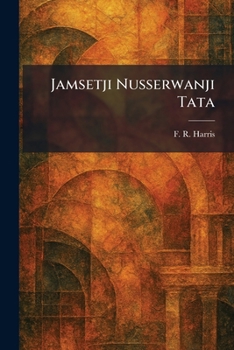
Jamsetji Nusserwanji Tata

"Jamsetji Nusserwanji Tata" is a definitive biography of the visionary industrialist often hailed as the father of modern Indian industry. Written by F.R. Harris, this account chronicles the life and legacy of a man whose pioneering spirit fundamentally transformed the economic landscape of India during the late nineteenth and early twentieth centuries.
The narrative explores Tata's monumental contributions to his nation's development, focusing on his three great ambitions: the establishment of a world-class iron and steel industry, the creation of a massive hydroelectric power scheme, and the founding of a premier institute for technical education and research. Harris provides a detailed look at Tata's perseverance in the face of colonial-era bureaucratic challenges, his strategic business acumen, and his unwavering belief that a nation's strength lies in its industrial and educational self-reliance. From his early success in the textile industry to his far-reaching philanthropic endeavors, the book captures the essence of a leader who prioritized national welfare alongside commercial success. This biography serves as an essential historical document for those interested in Indian history, industrialization, and the biography of a figure whose enduring impact is still felt globally today.
This work has been selected by scholars as being culturally important, and is part of the knowledge base of civilization as we know it. This work was reproduced from the original artifact, and remains as true to the original work as possible. Therefore, you may see the original copyright references, library stamps (as most of these works have been housed in our most important libraries around the world), and other notations in the work.
This work is in the public domain in the United States of America, and possibly other nations. Within the United States, you may freely copy and distribute this work, as no entity (individual or corporate) has a copyright on the body of the work.
As a reproduction of a historical artifact, this work may contain missing or blurred pages, poor pictures, errant marks, etc. Scholars believe, and we concur, that this work is important enough to be preserved, reproduced, and made generally available to the public. We appreciate your support of the preservation process, and thank you for being an important part of keeping this knowledge alive and relevant.
Customer Reviews
ThriftBooks ® and the ThriftBooks ® logo are registered trademarks of Thrift Books Global, LLC
