


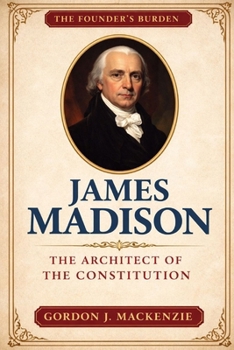
James Madison: The Architect of the Constitution

James Madison built the American constitutional machine, then spent the rest of his life trapped inside it. He is remembered as a quiet intellect in a room full of louder men, but the Republic's survival depended on his particular kind of genius: not speeches, not theatre, but structure. Madison understood that liberty does not endure on virtue alone. It endures when institutions are engineered to restrain ambition, absorb conflict, and force factions to negotiate inside rules instead of fighting outside them.
The Founder's Burden: James Madison follows the full arc of the architect who turned the Revolution's promise into a workable system of government. Madison watched the Confederation years teach Americans the most dangerous habit a new nation can learn: treating national obligations as optional. Congress could request; states could ignore. Credit collapsed, commerce fractured, treaties weakened, and foreign powers learned they could squeeze the United States cheaply. Madison did not romanticise that chaos as freedom. He saw it as the early stage of disunion.
In Philadelphia, Madison arrived with a plan shaped by failure. He wanted a national government capable of acting in national spheres, but restrained through checks, balances, and competing institutions. His central insight was blunt and enduring: faction is permanent. People pursue interest, form groups, justify themselves in moral language, and try to capture power. The solution is not preaching. The solution is design. A large republic can dilute dangerous faction by multiplying interests, while separated branches and divided levels of government can force ambition to discipline ambition.
But Madison's burden was not only building the Constitution. It was living with it. Within a few years, he watched the new federal system begin to expand through finance and administrative innovation, led by Alexander Hamilton. Madison feared that rapid consolidation would make the government look like elite capture and trigger public rejection of the entire constitutional bargain. His response was to organise opposition with Jefferson, helping shape the early party system (the very factional reality he had predicted). He delivered the Bill of Rights to anchor legitimacy and reassure a public still anxious about central authority, even while believing the deepest protection lay in structural restraint rather than promises on paper.
Then the world forced Madison into the test he least wanted: war. As President, he faced foreign pressure that made neutrality unsustainable and domestic politics that punished every partial measure. The War of 1812 pushed the Republic toward capacity-building (money, coordination, enforcement) while tempting it toward emergency habits that can permanently expand power. Madison did not seek war as glory. He managed it as survival, trying to strengthen national capacity without teaching Americans to treat crisis power as normal.
In the postwar years, Madison confronted a new struggle: what lessons would become permanent. Some Americans wanted stronger national instruments and rapid development. Madison understood the need for capacity, but he resisted turning the Constitution into a permission slip for whatever seemed useful. In retirement, he became a guardian of meaning, warning against both unchecked central appetite and the return of Confederation logic through doctrines that treat federal law as optional.
This is the story of a founder who believed a republic survives only when restraint is engineered, legitimacy is maintained, and conflict is channelled into institutions instead of spilling into rupture. Madison's life proves that the hardest part of liberty is not winning it. It is designing it to last.
Customer Reviews
ThriftBooks® and the ThriftBooks® logo are registered trademarks of Thrift Books Global, LLC
