


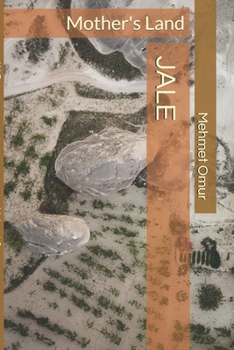
Jale: Mother's Land

JALE; Mother's Land
I don't know where my mother went; and although I know where I took these photographs, I still don't know where these forms came from.
This book brings together forty-four abstract and near-abstract photographs drawn from a substantial body of work built over fourteen journeys to Cappadocia and four stays in Iceland. Selected from tens of thousands of images, they result from a process of distillation: reducing the world to its signs, and privileging perception over identification.
The project probes the boundary between landscape and abstraction. The images sometimes retain clues of origin--a topography, a texture, a light--yet they refuse a documentary anchor. This withdrawal of place structures the act of looking: the viewer is placed before a form of productive uncertainty, oscillating between recognition and indeterminacy, fascination and resistance to immediate interpretation.
The series thus belongs to an inquiry into trace: what matter preserves, what time alters, what light reveals or erases. Each photograph functions as a perceptual threshold, where the real becomes structure, rhythm, surface, stratification.
The title and conceptual axis of the book are tied to a biographical dimension, treated without illustrative narration. The disappearance of the author's mother--an absence that remains without a location--forms an ethical and sensitive backdrop: not a represented subject, but a condition of seeing. The name "Jale," a rare word in French that can evoke a pearly pink (rose-pearl), acts as a chromatic and symbolic note: a discreet, persistent presence that guides the reading without imposing it.
Conceived as a coherent whole, the book offers an experience of contemplation and attention. It does not seek to describe a territory, but to make a relationship perceptible: between memory and matter, between disappearance and persistence, between the visible and what eludes it.
Customer Reviews
ThriftBooks ® and the ThriftBooks ® logo are registered trademarks of Thrift Books Global, LLC
