


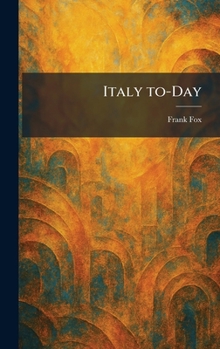
Italy To-Day

"Italy to-Day" offers a compelling and detailed examination of the Italian nation during a pivotal moment in the early 20th century. Written by acclaimed journalist and author Frank Fox, this work provides a contemporary perspective on the dramatic social, political, and economic transformations occurring in Italy during the late 1920s.
The narrative delves into the rise of Fascism under Benito Mussolini, exploring how the movement reshaped the daily lives of citizens and the structural foundations of the state. Fox combines keen observation with analytical depth to discuss topics ranging from agricultural reforms and industrial progress to the psychological state of the Italian people. As a primary source of geopolitical observation, the book captures the tension between tradition and the modernizing impulses of a new regime.
Readers interested in European history, the evolution of political ideologies, and the specific historical context of interwar Italy will find "Italy to-Day" an invaluable resource. It serves as both a travelogue of a nation in flux and a serious study of a society undergoing a radical shift in identity. This work stands as a significant historical document, reflecting the complexities and controversies of a country that would soon become central to the global stage during the Second World War.
This work has been selected by scholars as being culturally important, and is part of the knowledge base of civilization as we know it. This work was reproduced from the original artifact, and remains as true to the original work as possible. Therefore, you may see the original copyright references, library stamps (as most of these works have been housed in our most important libraries around the world), and other notations in the work.
This work is in the public domain in the United States of America, and possibly other nations. Within the United States, you may freely copy and distribute this work, as no entity (individual or corporate) has a copyright on the body of the work.
As a reproduction of a historical artifact, this work may contain missing or blurred pages, poor pictures, errant marks, etc. Scholars believe, and we concur, that this work is important enough to be preserved, reproduced, and made generally available to the public. We appreciate your support of the preservation process, and thank you for being an important part of keeping this knowledge alive and relevant.
Customer Reviews
ThriftBooks ® and the ThriftBooks ® logo are registered trademarks of Thrift Books Global, LLC
