


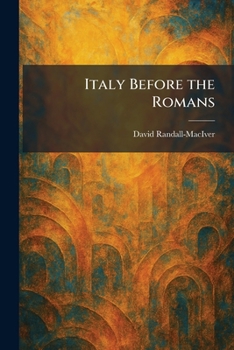
Italy Before the Romans

Select Format
Select Condition 
Book Overview
"Italy Before the Romans" provides an authoritative and comprehensive overview of the archaeological and cultural landscape of the Italian peninsula prior to the rise of the Roman Empire. Written by the renowned archaeologist David Randall-MacIver, this work explores the complex tapestry of Iron Age civilizations that inhabited the region, including the Etruscans, Villanovans, and other diverse tribal groups.
The study delves into the material remains, burial customs, and artistic expressions of these early peoples, offering a detailed analysis of their social structures and regional variations. By examining the transition from the Bronze Age to the Iron Age, Randall-MacIver clarifies the foundations upon which Roman civilization was eventually built. This scholarly yet accessible investigation remains a vital resource for understanding the origins of ancient Italy, highlighting the sophistication of the pre-Roman cultures that shaped the Mediterranean world. "Italy Before the Romans" is an essential volume for historians, archaeologists, and anyone interested in the foundational history of Western Europe and the ancient Mediterranean.
This work has been selected by scholars as being culturally important, and is part of the knowledge base of civilization as we know it. This work was reproduced from the original artifact, and remains as true to the original work as possible. Therefore, you may see the original copyright references, library stamps (as most of these works have been housed in our most important libraries around the world), and other notations in the work.
This work is in the public domain in the United States of America, and possibly other nations. Within the United States, you may freely copy and distribute this work, as no entity (individual or corporate) has a copyright on the body of the work.
As a reproduction of a historical artifact, this work may contain missing or blurred pages, poor pictures, errant marks, etc. Scholars believe, and we concur, that this work is important enough to be preserved, reproduced, and made generally available to the public. We appreciate your support of the preservation process, and thank you for being an important part of keeping this knowledge alive and relevant.
Customer Reviews
ThriftBooks ® and the ThriftBooks ® logo are registered trademarks of Thrift Books Global, LLC
