


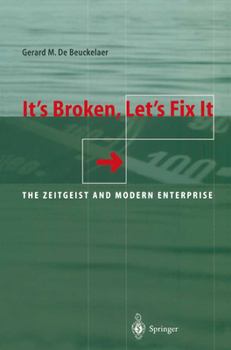
It's Broken, Let's Fix It: The Zeitgeist and Modern Enterprise
No Customer Reviews

We used to have this saying: "Ifit ain't broken, don't fix it." That was a pow- erful piece of wisdom. It meant: "Ifsomething should, against all odds, func- tion properly, then do not touch it, you might make things worse!" But then, the re-engineering fashion emerged, and somebody whom I used to deeply admire as one of the most brilliant teachers I ever saw at work, when he was still an Assistant Professor of Electrical Engineering at the Massachusetts In- stitute of Technology (MIT), coined the phrase: "Ifit is not broken: break it!" Now that is obvious non-sense on a logical level, but is it on a social level? Society, and thus business, is driven by fashions. Some of us call it fads. There have been more of those than I care to list here. The more colorful, the moreattention it gets.Attention translates more exuberant the statement, the into book salesand lecture fees.But it does not stop there.Very obviously, the more you pay for a speaker, the higher the distribution numbers for his book, the "truer" his message must be! Wewill revisit the "strange loops" caused by recursion often in this book. Let's start with one example. Did I pay a lot for this lecture because it is good, or is it good because it is expensive? One can very easily see a mechanism here that will make us gravitate towards ever louder and shallower truths.
Format:Paperback
Language:English
ISBN:3642086721
ISBN13:9783642086724
Release Date:December 2010
Publisher:Springer
Length:284 Pages
Customer Reviews
0 rating
Copyright © 2026 Thriftbooks.com Terms of Use
| Privacy Policy | Do Not
Sell/Share My Personal Information | Cookie Policy | Cookie Preferences | Accessibility Statement
ThriftBooks® and the ThriftBooks® logo are registered trademarks of Thrift Books Global, LLC
ThriftBooks® and the ThriftBooks® logo are registered trademarks of Thrift Books Global, LLC
