


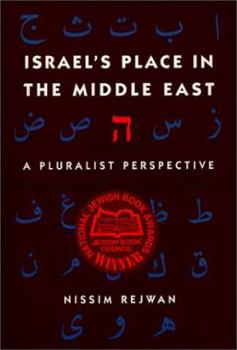
Israel's Place in the Middle East: A Pluralist Perspective


Select Format
Select Condition 
Book Overview
"An important book. . . . No other is available in English with both the information and the perspective provided by Nissim Rejwan. . . . He sets out to demystify prevailing assumptions and attitudes... This description may be from another edition of this product.
Format:Paperback
Language:English
ISBN:0813017238
ISBN13:9780813017235
Release Date:August 1999
Publisher:University Press of Florida
Length:224 Pages
Weight:0.80 lbs.
Dimensions:9.3" x 0.8" x 6.0"
Related Subjects
History Political Science Politics & Social Sciences Religion Religion & SpiritualityCustomer Reviews
1 rating
Some valuable insights
Published by Thriftbooks.com User , 21 years ago
It's nice to admit that Israel is a part of the Middle East. Actually, anyone could figure that out just by looking at a map. And when one visits Israel, well, it sure looks like the Middle East. The people look Middle Eastern. The language is Middle Eastern. And you can bet the food is Middle Eastern. Rejwan discusses the linguistic evidence that Israelis and Arabs have plenty of common culture. That certainly makes sense. But this book goes beyond that to envision a pluralist society. Well, does that mean pluralism in Israel's Arab neighbors? So that Jews can be part of the societies in those nations? If pluralism means that Israel gives everyone human rights, that's fine. But Israel also has a purpose: to serve as the Jewish homeland, the Jewish capital, a refuge for Jews if they need one, and a place where Jewish rights will not be infringed upon. That's no more than the rights other nations afford their nationals. Let's see if that counts as pluralism. I think it does. But Rejwan never agreed. We then see a discussion of Arab antisemitism. And the author thinks it's overrated. The idea of an Arab slaughter of Jews is preposterous to him. It is as if the Arabs are merely, um, here. And not special or anything. And as if they don't really do much, so they won't really kill Jews. But I don't buy that argument. This book was written six years ago. And Arabs have indeed been killing Jews. And I can't agree with the author about Arab antisemitism being a mere political tool. One could have said the same thing about German antisemitism in 1900, but look what it became in just forty years. Yes, Arabs and Jews did live together for centuries. But most of the time, Jews were dhimmis. Are most Arabs really willing to live with Jews as equals? Rejwan hasn't convinced me of that. On the other hand, Rejwan does a splendid job of analyzing the complaints about Israel being an alien European entity. The Israelis are indeed Middle Eastern, and we ought to encourage people such as Rejwan who point this out. Rejwan would have done well to extend such arguments to the Law of Return (which is no more than similar laws other nations have with respect to what they see as their nationals). And he might have exchanged the concept of the myth of redemption for the very real act of immigration. Rejwan cites some statistics from a 1988 poll. 72 percent of Israeli Arabs objected to the Law of Return. Um, without the Law of Return, Israel would lose much of its national purpose. 70 percent of Israeli Arabs regarded Zionism as racist. Um, really? All Zionism amounts to is human rights. Is that racist? Obviously not. 1 percent of Israeli Arabs regarded themselves as Zionists, 47 percent of them were antizionists. This makes no sense to me. For me, the question "Are you a Zionist" is no different than "Do you support human rights?" I can't see a reason to say no. Rejwan should have taken the time to say this. Bu
Copyright © 2026 Thriftbooks.com Terms of Use
| Privacy Policy | Do Not
Sell/Share My Personal Information | Cookie Policy | Cookie Preferences | Accessibility Statement
ThriftBooks® and the ThriftBooks® logo are registered trademarks of Thrift Books Global, LLC
ThriftBooks® and the ThriftBooks® logo are registered trademarks of Thrift Books Global, LLC
