


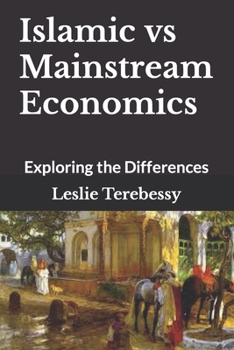
Islamic vs Mainstream Economics: Exploring the Differences
No Customer Reviews

The analysis presented here argues that the problems afflicting present-day economies arise primarily from interest-based banking. In contrast to the teaching of mainstream economic theory, interest as an incentive for ensuring an efficient allocation of resources simply does not, and cannot, achieve results that are comparable to those achieved when profit is used for the purpose. Significant differences exist between profit and interest as incentives for the efficient allocation of capital. These differences produce important consequences not just on how resources are allocated, but also on how the rewards of productivity are distributed. To make matters worse, with a few exceptions, all analysis takes place within the Keynesian or neo-Keynesian paradigm. Keynesian analysis is flawed and thus unfit to provide reliable analysis. The work presented here recommends adopting a paradigm that is free of interest as an incentive for rewarding economic enterprise. It tries to demonstrate that resources are allocated more efficiently when profit rather than interest is used as the incentive to reward economic activity. Islamic finance has not been palpably successful in addressing different macroeconomic challenges. In replicating mainstream finance, "Islamic" finance produces debt-like structures, with income and capital guarantees that make them little different from interest-bearing bonds. Thus, we are witnessing a conventionalisation of Islamic finance rather than the Islamisation of conventional finance. The main flaw in the present-day economic theory is the perception that interest is a suitable incentive for rewarding participation in production. On the contrary, interest-based finance produces a range of harmful system-wide effects. These encompass inefficiency, indebtedness, inflation, unemployment, stagnating growth, cyclical instability and uneven distribution of wealth. As the problems mentioned above are produced by interest-based financing, it follows that they should be addressed by replacing debt financing with risk sharing as the preferred way of financing. The work presented here is based on a decade of teaching economic theory, as well as another decade of research in Islamic banking and finance at IAIS Malaysia. The research presented here draws on both sources.
Format:Paperback
Language:English
ISBN:B095GRQJGF
ISBN13:9798506876359
Release Date:May 2021
Publisher:Independently Published
Length:220 Pages
Weight:0.66 lbs.
Dimensions:0.5" x 6.0" x 9.0"
Customer Reviews
0 rating
Copyright © 2026 Thriftbooks.com
Terms of Use | Privacy Policy | Do Not Sell/Share My Personal Information | Cookie Policy | Cookie Preferences | Accessibility Statement
ThriftBooks ® and the ThriftBooks ® logo are registered trademarks of Thrift Books Global, LLC
ThriftBooks ® and the ThriftBooks ® logo are registered trademarks of Thrift Books Global, LLC
