


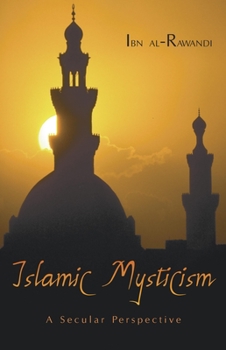
Islamic Mysticism: A Secular Perspective

Select Format
Select Condition 
Book Overview
No Marketing Blurb This description may be from another edition of this product.
Format:Hardcover
Language:English
ISBN:1573927678
ISBN13:9781573927673
Release Date:May 2000
Publisher:Prometheus Books
Length:260 Pages
Weight:0.98 lbs.
Dimensions:0.8" x 6.0" x 9.0"
Customer Reviews
4 ratings
Brave and Honest Book
Published by Thriftbooks.com User , 20 years ago
Ibn Al Rawandi's book is a rare example of someone who puts people and human rights before ideology. In this time where ultra-right Christian fanatics and Islamist fanatics actively kill each other and advocate yet more violence, Ibn Rawandi urges caution and thoughtfulness and respect for human rights. He advocates studying honestly the history of Sufism to provide a new, critical analysis of Islam. This of course offends the partisans of reactionary Islamism as well as traditionalists, who hate democracy and rational inquiry. The book bravely takes on the traditionalist Sufi and cult leader Frithjof Schuon, who was accused of child molestation in 1991. Charges against Schuon were dropped, evidently due to cult pressure. The Schuon group has sought to intimidate anyone critical of them since then. It's no wonder they denounce Ibn al Rawandi's book, since they still need to cover up for their Master's abuses. But the truth is that since 1991, and despite intimidation, many have come forward and supplied new evidence that shows that Schuon was indeed a polygamist and had strange mystico-sexual rites in which children were involved. One of Schuon's four wives , Maude Murray, supplied evidence against her husband, for instance. In any case, Ibn al Rawandi's book is to be praised for its effort to find the truth in an age of fanaticism and religious wars. His support of human rights over and above fanatical traditionalist ideologues is commendable.
Rational Anti-mysticism: Healthy debunking
Published by Thriftbooks.com User , 22 years ago
Islamic Mysticism: A Secular Perspective by Ibn Al-Rawandi (Prometheus Books) Any believer needs to fairly read some debunking views of one's beliefs. First it is always important to know other points of view, even if they do not persuade or even tend to subvert the truth of the positions one holds as true and life-saving. This book offers a critique of the Sufi path of transformation by a former seeker who feels there is serious deception and self-deception on the spiritual path and it is better to be rational and consistent in one's views than to seek fantastical delusions. Now such a position is unlikely to appeal to the mystic but if one wants to mature in one's mysticism one should give such nay-sayers a careful hearing, concede their good points and carefully critique the limitations of their point of view. Otherwise perhaps such rationalists are correct and such pursuits are bunk.
A Note to the Reader
Published by Thriftbooks.com User , 24 years ago
Ibn Al-Rawandi ...died more than a thousand years ago. Ibn Al-Rawandi the author of this book lives today, As a matter of fact he dedicated the book to his mother 1903-, and inside the book he discussed the views of modern - twentieth century - thinkers as P. Crone and M. Cook who published a book together 1980's, and probably the author assumed the alias Ibn Al-rawandi for himself. To clear the Matter to the reader I add the following two notes:Ibn Al-Rawandi( 9th century): The moslem notion that the Koran, no one can produce like it and also - this came later by moslem theoligians - the Koran is as eternal as Allah itself and therefore was not created. was rejected by Nazzam a famous reasonable moslem theologian who was by no means secular. Nazzam saw that notion is damaging to islam especially among the intellectuals, so he said that the Arabs contemporary of Mohammad were able to write like Koran. But he then maintained that Allah stopped the Arabs from doing so as a proof to his prophet. This last statement by Nazzam is not strictly true, for some Arab contemporary to the prophet Mohammad did compose like Koran and their works was destroyed when Islam became dominant. These Statement by Nazzam that the Arab were able to produce like Koran - as the head of Arabic literatures Taha Hussein said in his Phd thesis - caused a great impact on Moslem free thinkers as Ibn Al-Rawandi and Abul-Ala Al Muary who wrote books challenging the Koran. Muary wrote a 4 volumes books in the same pattern as Koran, 3 were lost or destroyed and only the first volume survived. Although Muary and Rawandi shared the same views about religion, Rawandi was hedonist a wine drinker, Muary wasn't, he was strictly vegetarian never married wished if the human race perished from the earth even in one poem he gave the wolf a nobel position than man. Muary came after Rawandi and attacked him for his hedonismm but there is an important point about Muary which even today great sholars have not noticed, Muary was believing in many of the things h's criticizing Rawandi ofIbn Al-Rawandi (Today), the BookThe book is very great, terse and compact. The author tried to be exact and offered the views of many modern researchers. It will appeal to the neutral objective reader who seekd the Truth about Isalm
Scholarly, critical analysis of Islamic religion & history.
Published by Thriftbooks.com User , 26 years ago
Rawandi contends that reliable sources undermine the classical account of Islam and Sufism, and his study seeks to rectify this imbalance through studying the philosophy of religion and traditionalists to provide a new, critical analysis of Islam. Readers already well versed in Islamic religion and history will find this a scholarly, detailed probe.
Copyright © 2026 Thriftbooks.com
Terms of Use | Privacy Policy | Do Not Sell/Share My Personal Information | Cookie Notice | Cookie Preferences | Accessibility Statement
ThriftBooks ® and the ThriftBooks ® logo are registered trademarks of Thrift Books Global, LLC
ThriftBooks ® and the ThriftBooks ® logo are registered trademarks of Thrift Books Global, LLC
