


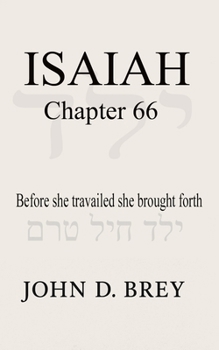
Isaiah Chapter 66
No Customer Reviews

Isaiah 66 stands as one of the most densely layered and contested passages in the Hebrew Bible. Its language of the "sign" lifted to the nations, the "tree in the midst," and the figure whose hands are spread and spoiled has generated centuries of exegetical debate. This study situates Isaiah's final chapter within the broader framework of biblical intertextuality and textual transmission. Attention is given to the semantic range of Hebrew terms such as אוֹת ("sign"), קשת/קשט ("ornament"), and the variant readings surrounding Psalm 22:16 (כארי vs. כארו) as attested in the Masoretic Text, the Septuagint, and the Dead Sea Scrolls. The work further engages the interpretive strategies of classical Jewish commentators-Rashi, Radak, Ibn Ezra, and Hirsch-whose readings reveal both striking insight and internal inconsistency. By tracing parallels between Genesis 2, Isaiah 25, Isaiah 61, and Isaiah 66, the study highlights recurring motifs: the singular versus the grove, the tree of life entwined with the tree of knowledge, the blossoming bosom as a sign of virginity, and the hands spread in affliction. The result is an exegetical inquiry that probes the instability of textual traditions while drawing out their theological implications. Isaiah Chapter 66 will appeal to readers interested in philology, intertextual analysis, and the history of biblical interpretation. It challenges the student of scripture to read the prophetic text with the seriousness demanded by its linguistic, literary, and historical complexity.
Format:Paperback
Language:English
ISBN:B0FRG7J373
ISBN13:9798265827319
Release Date:September 2025
Publisher:Independently Published
Length:68 Pages
Weight:0.17 lbs.
Dimensions:0.2" x 5.0" x 8.0"
Customer Reviews
0 rating
Copyright © 2026 Thriftbooks.com Terms of Use
| Privacy Policy | Do Not
Sell/Share My Personal Information | Cookie Policy | Cookie Preferences | Accessibility Statement
ThriftBooks® and the ThriftBooks® logo are registered trademarks of Thrift Books Global, LLC
ThriftBooks® and the ThriftBooks® logo are registered trademarks of Thrift Books Global, LLC
