


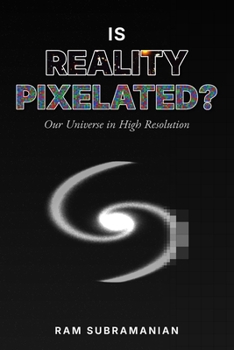
Is Reality Pixelated?: Our Universe in High Resolution

Is the universe running on a computer?
A physicist puts the odds at zero. A computer scientist puts them at one hundred percent. Is Reality Pixelated? examines the evidence behind both answers.
A screen is called high resolution when no eye can find its dots, yet high resolution is still resolution. Drawing on landmark experiments, peer-reviewed physics, and thinkers from Max Tegmark to Richard Dawkins, the chapters follow the clues:
a smallest scale where space itself seems to run out of resolutiona cosmic speed limit that behaves like a processor's clockparticles that stay undecided until they are measuredblack holes that store information like a compressed filelaws of nature that look like code, and anomalies that look like bugsThe book also takes up the strongest objections: Nick Bostrom's trilemma and what the odds really say, a 2025 argument that logic forbids any simulated universe, and the cost of computing a cosmos. Thirty-six original diagrams, Evidence boxes, "Skeptic's Corner" boxes that give the other side its say, and a Further Reading Map accompany the text.
Customer Reviews
ThriftBooks ® and the ThriftBooks ® logo are registered trademarks of Thrift Books Global, LLC
