


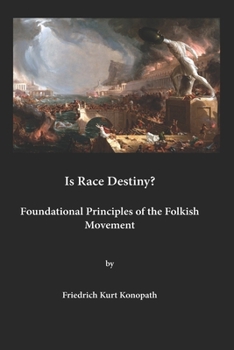
Is Race Destiny? Foundational Principles of the Folkish Movement
No Customer Reviews

The Folk is something closer to God, or the noumenal, the "thing-in-itself." It precedes and grounds our consciousness. The Folk is an "Idea" of God/Nature," given, not made-part of the divine structure of creation, a manifestation of how reality itself is ordered, not subject to individual invention. Concepts like "democracy" are chosen and pursued. This is "activity." When people recognize themselves as already constituted by something prior (the Folk as given reality), then their role is receptive-they don't choose it, they belong to it. This doesn't mean inaction. Instead, the new understanding relocates motive: action does not come from free-floating willpower but from one's rooted being. You act from your essence, not toward an arbitrarily chosen goal. In this brief introduction to the Folkish perspective, its foundational principles are outlined. It views history as a living, dynamic reflection of the Folk rather than of abstract "ideas" of an age or a random sequence of events, and it locates the essence of being within the collective. The book also outlines the foundational understanding of the distinct types within the European kind, the early migrations of the Northern peoples, history from a Folkish perspective, and most importantly, the Germanic worldview of our ancestors as expressed in the Edda. In addition, a very significant essay titled Folk and Folkdom by Wilhelm Stapel is included. This is the translation of Ist Rasse Schicksal? Grundgedanken der v lkischen Bewegung by Hanno Konopacki-Konopath (Friedrich Kurt Konopath). 28 original illustrations included.
Format:Paperback
Language:English
ISBN:B0FVRPSMGD
ISBN13:9798269217697
Release Date:October 2025
Publisher:Independently Published
Length:72 Pages
Weight:0.24 lbs.
Dimensions:0.1" x 6.0" x 9.0"
Related Subjects
PhilosophyCustomer Reviews
0 rating
Copyright © 2025 Thriftbooks.com
Terms of Use | Privacy Policy | Do Not Sell/Share My Personal Information | Cookie Policy | Cookie Preferences | Accessibility Statement
ThriftBooks ® and the ThriftBooks ® logo are registered trademarks of Thrift Books Global, LLC
ThriftBooks ® and the ThriftBooks ® logo are registered trademarks of Thrift Books Global, LLC
