


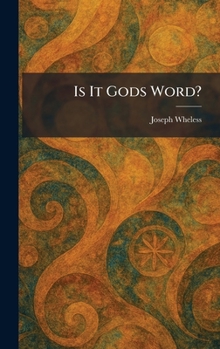
Is It Gods Word?

"Is It Gods Word?" is a rigorous and provocative examination of the Bible's claims to divine inspiration. Written by Joseph Wheless, a distinguished lawyer and dedicated freethinker, this work applies a legalistic and analytical lens to the scriptures, scrutinizing the Old and New Testaments for consistency, historical accuracy, and moral integrity.
Wheless meticulously catalogs internal contradictions, scientific inaccuracies, and ethical dilemmas found within the biblical text. By treating the Bible not as a sacred relic beyond reproach, but as a document subject to the rules of evidence and logic, the author challenges readers to reconsider the foundations of traditional faith. The book delves into the origins of various dogmas and myths, contrasting them with the rationalist and scientific understanding of the early 20th century.
This volume remains a significant contribution to the literature of skepticism and freethought. It serves as a comprehensive resource for those interested in biblical criticism, the history of religious debate, and the application of rational inquiry to ancient texts. "Is It Gods Word?" is an essential read for anyone seeking a deep, critical dive into the complexities and controversies surrounding the most influential book in Western history.
This work has been selected by scholars as being culturally important, and is part of the knowledge base of civilization as we know it. This work was reproduced from the original artifact, and remains as true to the original work as possible. Therefore, you may see the original copyright references, library stamps (as most of these works have been housed in our most important libraries around the world), and other notations in the work.
This work is in the public domain in the United States of America, and possibly other nations. Within the United States, you may freely copy and distribute this work, as no entity (individual or corporate) has a copyright on the body of the work.
As a reproduction of a historical artifact, this work may contain missing or blurred pages, poor pictures, errant marks, etc. Scholars believe, and we concur, that this work is important enough to be preserved, reproduced, and made generally available to the public. We appreciate your support of the preservation process, and thank you for being an important part of keeping this knowledge alive and relevant.
Customer Reviews
ThriftBooks ® and the ThriftBooks ® logo are registered trademarks of Thrift Books Global, LLC
