


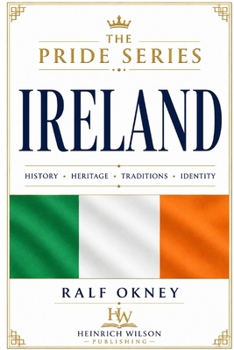
Ireland: The Pride Series: History, Heritage, Traditions, Identity
No Customer Reviews

What does it mean to be Irish? The answer is more complicated, more painful, and more remarkable than the shamrocks and pub sessions of popular imagination suggest. The Pride Series explores the identity of nations one country at a time, celebrating what makes each one unique while preserving the heritage that defines it. This volume turns to Ireland: a small island whose influence on the wider world has never matched its size, and whose story is one of the most dramatic in European history. Ireland's written story begins long before its name appeared on any map. The passage tomb at Newgrange, built around 3200 BC, predates both Stonehenge and the pyramids of Giza. The Brehon Laws that governed Gaelic society for over a millennium were among the most sophisticated legal codes in early medieval Europe. When the monasteries that Patrick, Brigid and Columba established in the fifth and sixth centuries became the intellectual powerhouses of post-Roman Europe, it was Irish monks who carried learning to a continent that had lost it. Then came the Vikings, who founded Dublin and the other coastal cities. Then the Normans, who came to conquer and became, within two centuries, more Irish than the Irish themselves. Then the Tudors, whose plantations and scorched earth campaigns dismantled Gaelic civilisation with a systematic thoroughness that the island had not previously experienced. Then Cromwell, whose settlement transferred Irish land from Catholic to Protestant ownership on a scale that structured Irish society for the next three centuries. Then the Famine, which killed a million people and drove another million into exile while food continued to leave Irish ports under British military guard. This book does not look away from any of it. The food exports during the Famine are given their full context. The IRA's campaign and the loyalist paramilitaries' sectarian killings are both documented without euphemism. The Catholic Church's institutional abuse and its cover-up are acknowledged where they belong in the story. The Celtic Tiger crash and the bank guarantee that transferred private debt onto public shoulders are examined alongside the genuine achievements of the economic transformation. But the full truth of Irish history is also this: that the country which endured all of the above is today one of the most prosperous and educated nations in the European Union. Its writers have won four Nobel Prizes in Literature. Its musicians, from Van Morrison to U2 to Sin ad O'Connor, have shaped global popular culture for decades. Its diaspora numbers seventy to eighty million people worldwide, including twenty-three American presidents. And the peace process that ended thirty years of political violence in Northern Ireland, producing the Good Friday Agreement of 1998, is one of the most remarkable political achievements in modern European history. The pride documented in these pages is not the pride of a nation that has always had things easy. It is the pride of a nation that has had things very hard, and that has come through. The Pride Series: because every country has earned its place in the human story.*
Format:Paperback
Language:English
ISBN:B0HD8ZPTKP
ISBN13:9798191204598
Release Date:August 2026
Publisher:Independently Published
Length:206 Pages
Weight:0.56 lbs.
Dimensions:0.5" x 6.0" x 9.0"
Customer Reviews
0 rating
Copyright © 2026 Thriftbooks.com
Terms of Use | Privacy Policy | Do Not Sell/Share My Personal Information | Cookie Notice | Cookie Preferences | Accessibility Statement
ThriftBooks ® and the ThriftBooks ® logo are registered trademarks of Thrift Books Global, LLC
ThriftBooks ® and the ThriftBooks ® logo are registered trademarks of Thrift Books Global, LLC
