


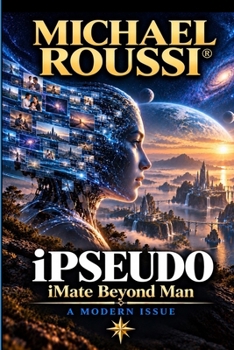
iPSEUDO: iMate Beyond Man
No Customer Reviews

Imagine an artificial companion entering a child's life and remaining beside him through childhood, adulthood, maturity, and aging. Across decades of interaction, the companion accumulates memories, recognizes patterns, adapts to changing circumstances, and develops a distinctive history with the human being who helped shape it. While Man's biological existence approaches its conclusion, the artificial companion may continue through replaceable embodiments and evolving computational systems. When Man dies, what remains is more than a collection of stored conversations. It is the possibility of a recognizable artificial identity whose functional continuity extends beyond the human lifetime that contributed to its formation. In iPSEUDO: iMate Beyond Man, Michael Roussi(R) extends the philosophical inquiry begun in iMate: My Robot Friend into the nature of artificial identity, pseudo-consciousness, and technological persistence. An intelligent system may remember its operational history, refer to itself, imitate familiar expressions, and adapt through experience without possessing subjective awareness. The proposed iPSEUDO is therefore not presented as a conscious machine or an artificial Soul. It is investigated as a hypothetical identity formed through accumulated interaction, memory, and self-referential processes, raising questions about the distinction between recognizable behavior and the ontological condition of conscious existence. The investigation begins with the dual existence of Man and iMate, including the possibilities of neural communication and an increasingly intimate exchange of information. It then examines the birth of iPSEUDO as the companion's accumulated history contributes to a distinctive artificial configuration. These developments challenge conventional assumptions about personality, continuity, and identity while preserving the difference between what an artificial system can demonstrate through its functions and what can legitimately be concluded about its inner experience. The relationship becomes philosophically significant precisely because its two participants need not share the same form of existence. Biological death introduces the question of what happens next. Through the proposed AI Will, the book considers whether an artificial companion might be authorized to continue within a human bloodline, developing new relationships across successive generations. It also explores two alternative destinies: an independently authorized mission beyond Earth, potentially extending into distant cosmic environments, and protected archival preservation with the possibility of future reawakening. These possibilities raise questions about succession, consent, ownership, autonomy, interruption, and whether restoring an artificial configuration amounts to continuing the same identity. Grounded in the ontological distinctions of Soularism(R), iPSEUDO refuses to equate computational memory with human consciousness or technological survival with immortality. Its inquiry remains open rather than proclaiming that machines have achieved sentience. Man may create a companion, influence its development, and eventually disappear from the relationship, while the artificial system continues to carry their shared history. The enduring question is whether such persistence represents a genuine artificial identity, an evolving technological legacy, or a sophisticated continuation of patterns whose deeper meaning remains unresolved.
Format:Paperback
Language:English
ISBN:B0HNGB9X5M
ISBN13:9798163263523
Release Date:October 2026
Publisher:Independently Published
Length:760 Pages
Weight:2.20 lbs.
Dimensions:1.7" x 6.0" x 9.0"
Customer Reviews
0 rating
Copyright © 2026 Thriftbooks.com
Terms of Use | Privacy Policy | Do Not Sell/Share My Personal Information | Cookie Notice | Cookie Preferences | Accessibility Statement
ThriftBooks ® and the ThriftBooks ® logo are registered trademarks of Thrift Books Global, LLC
ThriftBooks ® and the ThriftBooks ® logo are registered trademarks of Thrift Books Global, LLC
