


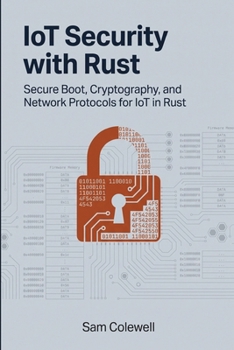
IoT Security with Rust: Secure Boot, Cryptography, and Network Protocols for IoT in Rust

Secure your connected devices from the silicon to the cloud.
The Internet of Things is expanding at a staggering pace, but this massive wave of connectivity has introduced unprecedented security challenges. Relying on legacy memory-unsafe languages like C and C++ is no longer viable. Today's embedded environment demands a new engineering mindset. You must architect systems that are mathematically and structurally resilient from the moment the first line of code is written.
IoT Security with Rust is your comprehensive, secure-by-design blueprint for engineering trustworthy connected devices. By combining low-level hardware control with strict compile-time guarantees, the Rust programming language empowers you to eliminate entire classes of vulnerabilities before your code ever reaches a physical device.
Moving from theoretical threat modeling to practical, hardware-level implementation, this guide provides actionable strategies for protecting resource-constrained microcontrollers against both remote exploits and physical hardware tampering.
Inside, you will discover how to:
Adopt a Defensive Engineering Mindset: Build structured threat models using STRIDE and asset-based analysis to identify attack surfaces across devices, gateways, and cloud backends.
Leverage Embedded Rust: Master ownership, borrowing, and the typestate pattern in no_std environments to eliminate buffer overflows, use-after-free errors, and undefined behavior.
Establish a Hardware Root of Trust: Anchor your software security in physical silicon using Secure Elements, Trusted Execution Environments, and cryptographic hardware fuses.
Build Verified Boot Chains: Implement secure boot processes using asymmetric cryptography to ensure only authentic, uncompromised code can execute.
Deploy Robust Cryptography: Utilize the RustCrypto ecosystem to perform secure key generation, elliptic curve digital signatures, and hardware-accelerated AES encryption.
Implement Secure Networking: Authenticate devices using Public Key Infrastructure and Mutual TLS, and secure lightweight application protocols like MQTT and CoAP.
Execute Fail-Safe OTA Updates: Design atomic over-the-air update pipelines with A/B partitioning and strict anti-rollback protections.
Defend Against Physical Attacks: Write constant-time code to thwart side-channel analysis and implement redundant logic to survive voltage glitching and fault injection.
Whether you are a traditional embedded developer looking to modernize your stack, a cybersecurity professional auditing physical hardware, or a software engineer transitioning into the IoT space, this guide bridges the gap between high-level programming and harsh hardware realities.
Stop reacting to vulnerabilities. Start building mathematically secure firmware today.
Customer Reviews
ThriftBooks ® and the ThriftBooks ® logo are registered trademarks of Thrift Books Global, LLC
