


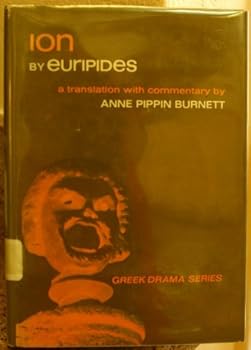
Ion (Prentice-Hall Greek drama series)

Select Format
Select Condition 
Book Overview
Ion is one of Euripides' most appealing and inventive plays. With its story of an anonymous temple slave discovered to be the son of Apollo and Creusa, an Athenian princess, it is a rare example of... This description may be from another edition of this product.
Format:Hardcover
Language:English
ISBN:0135060303
ISBN13:9780135060308
Release Date:January 1970
Publisher:Prentice-Hall
Length:157 Pages
Weight:0.90 lbs.
Customer Reviews
1 rating
Euripides exposes Apollo, the god of truth, as a liar
Published by Thriftbooks.com User , 20 years ago
"Ion" is one of many plays by Euripides in which he tried to show his Athenian audience that when judged by ordinary human standards the gods themselves would fall short. In this play, Apollo, the god of truth, brutally rapes a helpless young girl, Creusa, and then abandons her, which is not exactly something new for one of the Olympian deities. Creusa has a son (Ion), whom she abandons in a cave; when she goes back to find the child, he is gone. Years later she marries Xuthus, a solider of fortune who becomes king of Athens, which is where Euripides picks up the story. At the start of the play Xuthus and Creusa are childless and go to Delphi for aid. There they are told that Ion, a young temple servant who has been raised from infancy, is the son of Xuthus. Creusa, outraged that Apollo let their own son die but preserved the life of a child begotten by Xuthus on some Delphian woman, tries to have Ion killed. Of course, in reality, Ion is her own child, abandoned in that cave. Condemned to death by the Delphians, Creusa escapes Ion's vengeance by taking refuge at Apollo's altar. There the priestess presents the tokens that allow Creusa to recognize Ion as her own son. Telling him the truth about his father, Ion tries to enter the temple to demand of Apollo the truth. There is some academic debate over how much "Ion" reflects the noted religious skepticism of Euripides. After all, we can certainly believe that Creusa was raped by a human and that he child died in that cave and that the priestess who bore Ion was simply setting up a convenient fiction that would make her son the prince of Athens. Apollo is the subject of the indictment, but the gods who introduce and end the play are Hermes and Athena. However, I do consider "Ion" to be one of the best examples of Euripides's cynical view of the gods the Greeks were supposed to be worshipping. Athena forestalls a confrontation between Ion and Apollo, but this particular example of deus ex machina certainly rings hollow. After all, Delphi is Apollo's holy place and if Athena's words are true, he should be there to reveal the truth to his son instead. Ultimately, "Ion" is one of the more provocative of the extant plays of Euripides.
Copyright © 2026 Thriftbooks.com Terms of Use
| Privacy Policy | Do Not
Sell/Share My Personal Information | Cookie Policy | Cookie Preferences | Accessibility Statement
ThriftBooks® and the ThriftBooks® logo are registered trademarks of Thrift Books Global, LLC
ThriftBooks® and the ThriftBooks® logo are registered trademarks of Thrift Books Global, LLC
